

Training Structure
College of Sciences
Program
Pigments, Dyes, and Adsorbents: Structures and Characteristics
2 creditsMicrobiology
2 creditsNatural Aromatic Raw Materials: Production
2 creditsPhysiology and Practice of Sensory Analysis
2 creditsPhysics of Color
2 creditsAnalysis of Volatile Compounds
2 creditsChemometrics, statistical data analysis, experimental design
2 creditsRegulations and Formulation in Aromatics and Fragrances
2 creditsSeparation Techniques
2 creditsNatural Aromatic Raw Materials: Control and Application
2 creditsChemistry of Synthetic Odor Molecules 1
2 creditsProfessional Projects – Project Management
8 credits
Chemistry of Synthetic Odor Molecules 2
2 creditsInnovative Synthesis and Extraction Processes
2 creditsFormulation of Ingredients for Fragrances
2 creditsBio-based Chemistry
2 creditsCommunication and Career Integration
2 creditsFormulation of Ingredients for Aromatics
2 creditsEnd-of-Year Workshop
18 credits
Pigments, Dyes, and Adsorbents: Structures and Characteristics
Level of Education
4-year college degree
ECTS
2 credits
Training Structure
College of Sciences
This course is designed to introduce students to concepts related to pigments, dyes, and adsorbents, focusing on their structures and applications. Emphasis will be placed on applications in the fields of flavors and fragrances (food coloring, perfumery) and cosmetics (hair coloring, powders, toothpaste, etc.). Some sessions are specific to each of the two tracks (P1, Cosmetic Engineering; P2, Flavors and Fragrances) of the Master’s in Chemistry with a specialization in Cosmetic, Flavor, and Fragrance Engineering (ICAP). The course unit consists of lectures and tutorials.
Hourly volumes*:
CM: 10 a.m.
TD: 10 a.m.
Microbiology
Level of Education
4-year college degree
ECTS
2 credits
Training Structure
College of Sciences
Some fundamental concepts in microbiology will be covered to give students an overview of the diversity of microorganisms. The modes of nutrition and reproduction of bacteria in relation to the physicochemical parameters of the environment will be studied.
We will discuss the composition and role of the skin and gut microbiota.
The microbiological criteria used for quality control of cosmetic and food products will be defined.
Physical and chemical antimicrobial agents used to control microbial growth will be examined.
On a practical level, the focus will be on ensuring that students know how to handle bacteria and are familiar with microbiological safety protocols. Standard techniques for microbiological testing and assessing the effectiveness of preservatives will be applied to cosmetic products.
Hourly volumes*:
CM: 12:00 p.m.
Practical training: 8 hours
Natural Aromatic Raw Materials: Production
Level of Education
4-year college degree
ECTS
2 credits
Training Structure
College of Sciences
- Terms and Definitions of Natural Raw Materials (ISO/TC54 Standard “Essential Oils”)
- Methods for extracting volatile compounds: production of essential oils, extraction of flavor compounds, supercritical CO₂ extraction, the ESAM process, VMHD extraction, headspace extraction techniques, SPME…
- Characterization of volatile compounds: Gas Chromatography (GC), Ultra-Fast Gas Chromatography (UFGC), Flame Ionization Detector (FID), Gas Chromatography-Mass Spectrometry (GC-MS), GC-FTIR, Comprehensive Two-Dimensional Gas Chromatography (GC-GC), chiral chromatographic analysis, GC-olfactometry, electronic nose.
Hourly volumes*:
CM: 12:00 p.m.
Practical training: 8 hours
Physiology and Practice of Sensory Analysis
Level of Education
4-year college degree
ECTS
2 credits
Training Structure
College of Sciences
Course: Study of taste and smell (reception and transmission of signals, encoding of information, psychophysiological significance), basic concepts of sensory analysis.
Practical Work: Learning about reference compounds used in perfumery and aromatherapy. Description, comparison, memorization, determination of recognition thresholds, and application of the concepts of olfactory strength and volatility to the development of fragrance accords.
Hourly volumes*:
CM: 12:00 p.m.
Practical training: 8 hours
Physics of Color
Level of Education
4-year college degree
ECTS
2 credits
Training Structure
College of Sciences
This learning unit covers:
- the fundamentals of colorimetry, which make it possible to define an unambiguous measure of color based on psychophysical experiments.
- the principles and practical use of color measurement instruments (colorimeters and spectrocolorimeters).
- the principles of color reproduction, particularly in the context of fragrances and cosmetics.
The theoretical concepts are supplemented by a significant amount of observation and hands-on activities during the lab sessions.
Hourly volumes*:
CM: 12:00 p.m.
Practical training: 8 hours
Analysis of Volatile Compounds
Level of Education
4-year college degree
ECTS
2 credits
Training Structure
College of Sciences
Knowledge of gas chromatography and mass spectrometry techniques using electron impact ionization and a quadrupole mass analyzer for the analysis of volatile organic molecules.
1) GC-MS analyses of volatile organic compounds:
- Electron Impact (EI) Ionization Techniques
- Chemical Ionization (CI) Techniques
- Quadrupole (Q) Analysis Techniques
- GC/MS Couplings
2) Applications in organic chemistry analysis and the characterization of volatile samples.
Hourly Volumes*:
CM: 3:00 p.m.
TD: 5 hours
Chemometrics, statistical data analysis, experimental design
Level of Education
4-year college degree
ECTS
2 credits
Training Structure
College of Sciences
This course unit will cover the fundamental concepts and practical tools of chemometrics through: - statistical data analysis;
- the laws of probability;
- confidence interval estimation;
- parametric and nonparametric tests.
An introduction to experimental design will be offered at the end of the module.
Hourly volumes*:
CM: 7 a.m.
TD: 1:00 p.m.
Regulations and Formulation in Aromatics and Fragrances
Level of Education
4-year college degree
ECTS
2 credits
Training Structure
College of Sciences
- Overview of the Major Fragrance Families (SFP Classification)
- Regulations in the fragrance industry.
- Learning how to formulate “standard” bases for perfumery or aromatherapy.
Hourly volumes*:
CM: 10 a.m.
TD: 8:00 a.m.
Separation Techniques
Level of Education
4-year college degree
ECTS
2 credits
Training Structure
College of Sciences
The purpose of this course is to teach liquid-phase chromatography and gas-phase chromatography.
Hourly volumes*:
CM: 3:00 p.m.
TD: 5 hours
Natural Aromatic Raw Materials: Control and Application
Level of Education
4-year college degree
ECTS
2 credits
Training Structure
College of Sciences
- International Market for Natural Aromatic Raw Materials, Major Producers
- Major Fragrance Families
- Study of natural aromatic raw materials: chemical and olfactory characteristics
- Testing of essential oils in accordance with AFNOR standards
Hourly volumes*:
CM: 12:00 p.m.
Practical training: 8 hours
Chemistry of Synthetic Odor Molecules 1
Level of Education
4-year college degree
ECTS
2 credits
Training Structure
College of Sciences
Fragrance molecules are the raw materials needed to create a perfume. This course unit provides the necessary fundamentals in this field to any student pursuing a degree in fragrance and flavor engineering.
Hourly volumes*:
CM: 12:00 p.m.
Practical training: 8 hours
Professional Projects – Project Management
Level of Education
4-year college degree
ECTS
8 credits
Training Structure
College of Sciences
Time of year
Fall
The professional project bridges the gap between traditional practical work and laboratory or industry internships. It takes the form of a supervised project in which students are placed in a professional setting through collaborative (group) work based on the completion of a project addressing a problem identified by a company, local government, nonprofit organization, or academic institution. It is part of the core curriculum of the Master’s in Chemistry and is carried out under the supervision of a faculty member or industry professional serving as a mentor. Conducted throughout the semester, this project aims to integrate and reinforce the knowledge and skills acquired during the undergraduate and early Master’s programs through this professional scenario. These real-world scenarios will be directly related to the Master’s track chosen by the students. In addition to disciplinary skills in chemistry, students will also acquire interpersonal, organizational, and communication skills—which are intrinsically linked to project management—thereby equipping them for their future professional careers.
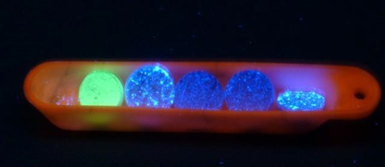
Addressing a research problem: an example of the synthesis of new phosphorescent materials.
Hourly volumes*:
CM: 5 hours
TD: 5 hours
Practical Training: 40 hours
Chemistry of Synthetic Odor Molecules 2
Level of Education
4-year college degree
ECTS
2 credits
Training Structure
College of Sciences
Examine the major chemical families of odorant molecules from both a chemical and olfactory perspective.
Acquire fundamental knowledge in the field of industrial synthesis and hemisynthesis of odorant molecules, their olfactory characteristics, and their applications in the aromatic industry and/or perfumery
Hourly volumes*:
CM: 12:00 p.m.
TD: 8:00 a.m.
Innovative Synthesis and Extraction Processes
Level of Education
4-year college degree
ECTS
2 credits
Training Structure
College of Sciences
This course is shared among MI students in the Master’s in Chemistry program: ICAP P1, ICAP P2, MAT P1, MAT P2, and BM (second semester). The following topics will be covered:
- The 12 Principles of Green Chemistry and Units of Measurement in Green Chemistry;
- Synthesis Strategies in Sustainable Chemistry;
- Alternative or environmentally friendly solvents for synthesis and extraction;
- Unconventional Activation Techniques and Applications.
CM: 13
TD: 7 H
Formulation of Ingredients for Fragrances
Level of Education
4-year college degree
ECTS
2 credits
Training Structure
College of Sciences
Fragrance formulation
Analysis of the constraints associated with the intended application (stability, physicochemical properties, cost, regulations, etc.)
Application
Hourly volumes*:
CM: 12:00 p.m.
TD: 8:00 a.m.
Bio-based Chemistry
Level of Education
4-year college degree
ECTS
2 credits
Training Structure
College of Sciences
The following topics will be covered:
- Bio-based solvents
- Fuels derived from biomass
- Antioxidants derived from lignin
- Metal catalysts derived from plants
- Surfactants derived from renewable resources
- Examples of industrial applications of enzymatic synthesis
Hourly Volumes*:
CM: 15
TD: 5
Communication and Career Integration
Level of Education
4-year college degree
ECTS
2 credits
Training Structure
College of Sciences
This learning unit will explore, in small groups or through individualized instruction, educational tools and best practices related to communication and career integration, through:
- assessments of knowledge, skills, competencies, interpersonal skills, and motivation;
- raising awareness of job-search techniques;
- CV and cover letter writing;
- rules for oral and written communication;
- mock job interviews.
Practical exercises directly related to the industries targeted by the students’ respective programs will be offered.
TP: 8:00 p.m.
Formulation of Ingredients for Aromatics
Level of Education
4-year college degree
ECTS
2 credits
Training Structure
College of Sciences
Evaluation of the aromatic intensity of the main flavor ingredients.
Direct and retronasal olfactory comparison.
Influence of the carrier on perception.
Formulation of flavorings and their application to food carriers with the assistance of a flavorist. Regulatory requirements.
Hourly volumes*:
CM: 12:00 p.m.
TD: 8: 00 a.m.
End-of-Year Workshop
Level of Education
4-year college degree
ECTS
18 credits
Training Structure
College of Sciences
A 4- to 6-month professional internship to be completed in a research or R&D laboratory in the flavor or fragrance industry.
The student intern will be assigned tasks related to the theoretical and practical knowledge acquired during the first and second semesters of the master’s program.
This internship can begin as early as March1.
Assessment criteria for the internship: a written report, an oral presentation, and the supervisor’s evaluation are the three components used to grade the internship.
Admission
Registration Procedures
Applications can be submitted through the following platforms:
- French and European students: Follow the “Mon Master” procedure on the website:https://www.monmaster.gouv.fr/
- International students from outside the EU: Follow the “Études en France” procedure:https://pastel.diplomatie.gouv.fr/etudesenfrance/dyn/public/authentification/login.html