


Intended Level of Study
Bachelor's degree (BAC +3)
ECTS
180 credits
Duration
3 years
Training Structure
School of Economics
Language(s) of Instruction
French
Overview
The Bachelor’s Degree in Economics is a generalist university program with a curriculum structured around the major fields of economic analysis. It offers core courses such as business economics, mathematics for economists, statistics, and the history of economic thought, as well as complementary disciplines such as political science, law, and organizational management. This program aims to develop analytical skills, a solid grounding in economics, and a comprehensive understanding of how markets, organizations, and institutions function.
ISO 9001-certified, the bachelor’s degree program offered by the Faculty of Economics at the University of Montpellier stands out for the quality and diversity of its tracks.
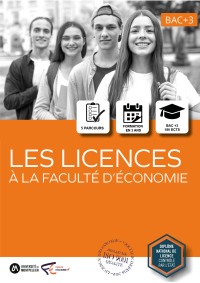
The Benefits of the Training Program
- A VARIETY OF BACKGROUNDS
- SUPPORT FOR ACADEMIC SUCCESS AND TUTORING
- A SOLID UNIVERSITY EDUCATION
Objectives
-
To provide students with a foundation in economics, particularly in microeconomics, macroeconomics, and economic policy.
-
To provide training in the analysis of the behavior and decisions of economic agents (households, businesses, and governments) within their national and international contexts.
-
Develop quantitative skills in mathematics, statistics, and data analysis tools applied to economics.
-
To acquire rigorous methods of reasoning and analysis that enable students to interpret complex economic phenomena.
-
To prepare students for further study, particularly in master’s programs in economics, business administration, finance, or related fields, as well as for a gradual transition into the workforce.
Expertise and Skills
Expertise
-
Analyze economic phenomena based on statistical data and economic indicators.
-
Use mathematical and statistical tools to model economic situations.
-
Interpret economic and social data using quantitative and qualitative methods.
-
Develop well-reasoned economic arguments, both in writing and orally.
-
Use computer and office software to process and present data.
Skills
-
Analytical and synthesis skills, to understand complex economic situations.
-
Methodological and scientific rigor, which is essential for the study of economic mechanisms.
-
Independence and work organization within a demanding academic environment.
-
Ability to work as part of a team and participate in group projects.
-
Ability to adapt, particularly to a variety of economic and professional environments.
International Dimension
Starting in their second year, students can spend a year (two semesters) at one of the 60 universities with which the School of Economics has partnerships through the ERASMUS+, inter-university agreements, and CHARM-EU exchange programs.
Organization
Knowledge Assessment
The Bachelor’s Degree in Economics, structured over three years and six semesters, is based on an assessment system designed to measure students’ learning progress in a gradual and comprehensive manner. At the end of each semester, the skills, competencies, and knowledge acquired in each course (UE) are assessed in one of two ways: through continuous assessment or a final exam.
Continuous assessment allows for regular monitoring of student progress through various forms of evaluation: proctored exams, graded tutorials, presentations, projects, document analyses, and active participation in class. This approach encourages regular attendance, consistent work, and the gradual acquisition of skills.
The final exam, on the other hand, consists of a written or oral test administered at the end of the semester. Its purpose is to assess the student’s overall mastery of the concepts taught and their ability to apply their knowledge in a structured and in-depth manner.
Depending on the learning outcomes or educational objectives, some courses may combine both assessment methods. These approaches ensure fair, diverse, and appropriate assessment tailored to the nature of the course, while allowing students to develop methodological skills, rigor, and independence throughout their academic career.
Special Features
Students with disabilities, young entrepreneurs, and elite athletes can receive personalized support.
This may take the form of academic accommodations, pedagogical adjustments, or specific rights, in order to enable students to best balance their personal or professional commitments with their university studies. Depending on the situation, these measures may include an adapted class schedule, modified assessment procedures, attendance accommodations, individualized support, or dedicated support services.
Internships, supervised projects
Internship | Possible |
|---|---|
Duration of the internship | A maximum of 924 hours, or 6 months |
Internship Abroad | Possible |
A true immersion in the professional world, it allows students to apply the knowledge they’ve acquired in class, discover how organizations operate, and compare theory with practice. To get the most out of it, thorough preparation is essential: learn about the host organization, define your goals, draw on what you’ve learned, and prepare for professional demands.
During the bachelor's degree program, internships are available but optional. They must be related to the program of study.
The internship may begin after the second-semester exams or take place during university breaks. In any case, it must end no later than August 31.
Program
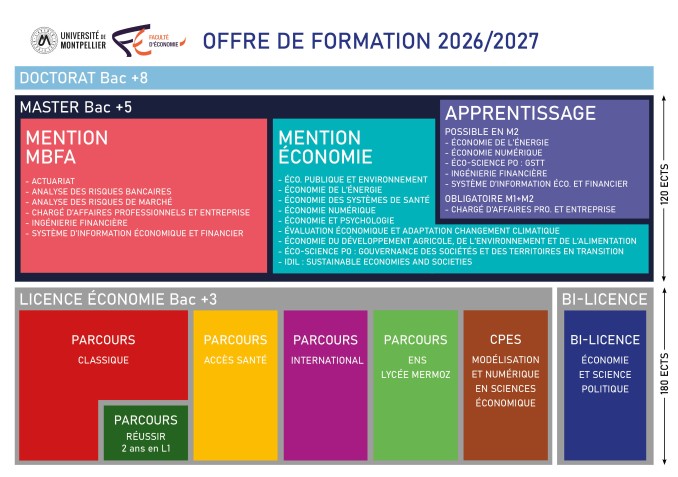
Select a program
Bachelor's Degree in Economics, Traditional Track
The Bachelor’s Degree in Economics is a generalist university program offering a comprehensive curriculum structured around the major fields of economic analysis. It includescore courses such as business economics, mathematics for economists, statistics, and the history of economic thought, as well as interdisciplinary courses in political science, law, and organizational management. This program aims to develop analytical skills, a solid grounding in economics, and a comprehensive understanding of how markets, organizations, and institutions function.
Throughout their studies, students can tailor their curriculum with a wide range of electives —including business law, institutional economics, cost accounting, economic and social policy, international finance, and environmental economics—allowing them to gradually specialize according to their academic or professional goals.
ISO 9001-certified, the bachelor’s degree program offered by the Faculty of Economics at the University of Montpellier guarantees the quality of its instruction, the continuous improvement of its teaching practices, and rigorous support for students throughout their academic journey.
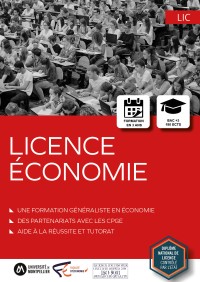
Business Economics
5 creditsPrinciples of Economics
5 creditsPolitical Science
4 creditsLaw
4 creditsHistory of Economic Events
5 creditsMathematics for Economists 1
5 creditsLANGUAGE SELECTION
2 creditsChoose one of the following two options:
English S1
2 creditsSpanish S1
2 credits
Optional
Mathematics and Statistics for Economists - 2 -
5 creditsGeneral Accounting
Macroeconomics 1
5 creditsStatistics 1
5 creditsMicroeconomics 1
5 creditsContemporary Economic Issues
4 creditsLANGUAGE SELECTION
2 creditsChoose one of the following two options:
English S2
2 creditsSpanish S2
2 credits
Optional
Microeconomics 2
6 creditsMathematics for Economists 3
5 creditsMacroeconomics 2
6 creditsSociology
4 creditsStatistics 2
5 creditsComputer Science S3
2 creditsLANGUAGE SELECTION
2 creditsChoose one of the following two options:
English S3
2 creditsSpanish S3
2 credits
Optional
Computer Science S4
2 creditsMacroeconomics 3
6 creditsStatistics 3
5 creditsOrganizational Management
5 creditsMicroeconomics 3
6 creditsLANGUAGE SELECTION: English or Spanish
2 creditsOPTIONS
2 creditsChoose 1 of 4
Business Law
2 creditsGeographic Economics
2 creditsInstitutional Economics
2 creditsEconomic Demographics
LANGUAGE SELECTION 2
2 creditsChoose one of the following two options:
Spanish Option
2 creditsEnglish Track
2 credits
Optional
History of Economic Thought
4 creditsGame Theory
4 creditsIntroduction to Econometrics
4 creditsIndustrial Organization
Economics of Growth
5 creditsLANGUAGE SELECTION
2 creditsChoose one of the following two options:
English S5
2 creditsSpanish S5
2 credits
List of Options 1
3 creditsChoose 1 of 4
Optimization
3 creditsPrivate Economic Analysis
3 creditsIn-Depth Analysis of Contemporary Economic Issues
3 creditsCost Accounting
3 credits
List of Options 2
3 creditsChoose 1 out of 6
Labor Economics
3 creditsUrban and Spatial Economics
3 creditsEnergy Transition
3 creditsHealth Economics
3 creditsDevelopment Economics
3 creditsIntroduction to Environmental Economics
3 credits
Optional
Financial Analysis
4 creditsData Analysis
3 creditsInternational Economics
4 creditsDatabase
4 creditsEconomic and Social Policy
5 creditsStudent Personal Project
2 creditsLANGUAGE SELECTION
2 creditsChoose one of the following two options:
English S6
2 creditsSpanish S6
2 credits
List of Options 1
3 creditsChoose 1 of 4
Applied Microeconomics
3 creditsSurvey Theory
3 creditsEconomic Analysis
3 creditsOperations Research
3 credits
List of Options 2
3 creditsChoose 1 out of 6
International Finance
3 creditsIntroduction to Environmental Economics
3 creditsEconomics and Psychology
3 creditsPolitical Economy
3 creditsDigital Economy
3 creditsHealth Economics
3 credits
Optional
Optional
Bachelor's Degree in Economics, International Track
The Faculty of Economics at the University of Montpellier offers an international program taught in English.
Students may choose this track starting in the second semester of their first year of study.
It is based on taking, in parallel with the general track’s bachelor’s degree courses, ten core courses taught in English—two courses per semester (from Semester 2 through Semester 6). These courses replace the equivalent courses taught in French. Thus, each semester, students enrolled in the international track follow the standard bachelor’s program, with two courses replaced by their English-taught equivalents. All of these courses, tutorials, and exams are conducted in English.
This program enables students to strengthen their command of academic English and prepare for further studies or a career in an international setting. It is particularly designed for students who wish to work in multicultural environments or pursue opportunities abroad.
ISO 9001-certified, the bachelor’s degree program offered by the Faculty of Economics at the University of Montpellier guarantees the quality of its instruction, the continuous improvement of its teaching practices, and rigorous support for students throughout their academic journey.
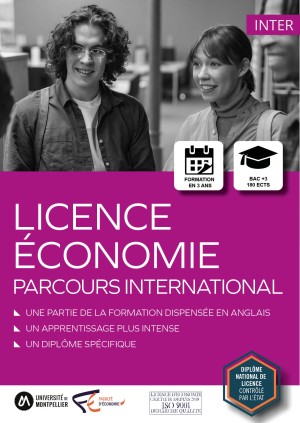
Business Economics
5 creditsPrinciples of Economics
5 creditsOptional Math Refresher Course
Political Science
4 creditsLaw
4 creditsHistory of Economic Events
5 creditsMathematics for Economists 1
5 creditsCHOICE 1
2 creditsChoose one of the following two options:
English S1
2 creditsSpanish S1
2 credits
Optional
Mathematics and Statistics for Economists - 2 -
5 creditsGeneral Accounting
Statistics 1
5 creditsEnglish S2
2 creditsMacroeconomics 1
5 creditsMicroeconomics 1
5 creditsContemporary Economic Issues
4 creditsOptional
English S3
2 creditsMathematics for Economists 3
5 creditsMacroeconomics 2
6 creditsSociology
4 creditsStatistics 2
5 creditsMicroeconomics 2
6 creditsComputer Science
2 creditsOptional
Macroeconomics 3
6 creditsEnglish S4
2 creditsComputer Science S4
2 creditsStatistics 3
5 creditsMicroeconomics 3
6 creditsOrganizational Management
5 creditsCHOICE 1
2 creditsChoose one of the following two options:
Spanish Option
2 creditsEnglish Track
2 credits
CHOICE 2
2 creditsChoose 1 of 4
Business Law
2 creditsGeographic Economics
2 creditsInstitutional Economics
2 creditsEconomic Demographics
Optional
History of Economic Thought
4 creditsGame Theory
4 creditsEnglish S5
2 creditsIntroduction to Econometrics
4 creditsIndustrial Organization
4 creditsGrowth Economics
4 creditsCHOICE 1
3 creditsChoose 1 out of 5
Optimization
3 creditsPrivate Economic Analysis
3 creditsIn-Depth Analysis of Contemporary Economic Issues
3 creditsCost Accounting
3 creditsHealth Economics
CHOICE 2
3 creditsChoose 1 out of 5
Labor Economics
3 creditsUrban and Spatial Economics
3 creditsEnergy Transition
3 creditsDevelopment Economics
3 creditsIntroduction to Environmental Economics
3 credits
Ecological Transition for Sustainable Development
2 creditsOptional
Financial Analysis
4 creditsEconomic and Social Policy
5 creditsData Analysis
3 creditsDatabase
4 creditsInternational Economics
4 creditsEnglish S6
2 creditsCHOICE 1
3 creditsChoose 1 of 4
Applied Microeconomics
3 creditsSurvey Theory
3 creditsEconomic Analysis
3 creditsOperations Research
3 credits
CHOICE 2
3 creditsChoose 1 out of 5
International Finance
3 creditsPolitical Economy
3 creditsEconomics and Psychology
3 creditsHealth Economics
3 creditsDigital Economy
3 credits
Optional
Choose one of the following two options:
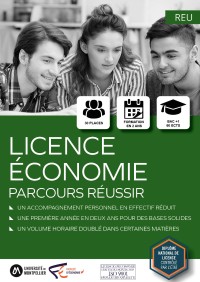
Bachelor's Degree in Economics, "Réussir" Track
The Bachelor’s Degree in Economics is a program that draws on knowledge of mathematics and statistics to analyze the decisions made by economic agents. The “Réussir” track is designed for students who do not meet the prerequisites for the standard Bachelor’s Degree in Economics program but whodemonstrate a strong motivation to succeed in this program.
It allows a group of 30 students to complete their first year of the economics bachelor’s degree in two years, with double the number of class hours in the core subjects of the economics bachelor’s program (mathematics, statistics, microeconomics, and macroeconomics). This program promotes gradual learning, enhanced academic support, and individualized student guidance.
At the end of the two-year “Réussir” track, students who have earned 60 ECTS credits will advance to the second year of their bachelor’s degree. They will then be able to continue their studies under conditions comparable to those of the traditional track.
Optional
Business Economics
5 creditsMath Remedial Course
2.5 creditsVoltaire Certification
English
2 creditsPrinciples of Economics
5 creditsStatistics
2.5 credits
Optional
Statistics
2.5 creditsMacroeconomics 1
2.5 creditsMathematics for Economists
2.5 creditsGeneral Accounting
Voltaire Certification
English
1 credit
Mathematics 2
2.5 creditsPolitical Science
4 creditsLaw
4 creditsHistory of Economic Events
5 creditsMicroeconomics
2.5 creditsOptional
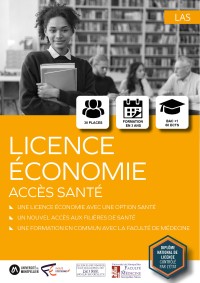
Bachelor's Degree in Economics, Health Care Track (LAS)
In France, admission to health professions programs—medicine, midwifery, dentistry, and pharmacy—is based on the MMOP entrance exam. The Licences Accès Santé (LAS) programs allow students to prepare for this exam while pursuing a bachelor’s degree in their chosen field, and offer the opportunity to submit up to two applications for the MMOP exam between the first and third years of the bachelor’ .
The Faculty of Economics at the University of Montpellier offers a Bachelor’s Degree in Health and Economics, designed for students who wish to pursue a degree in health sciences while acquiring a solid foundation in economics. This program provides a secure pathway, allowing students to continue their studies in a coherent manner even if they are not admitted to a health sciences program.
Students enrolled in the LAS in Economics pursue their bachelor’s degree within the School of Economics. The program consists of a portion of the core courses from the traditional Bachelor’s in Economics (48 ECTS), supplemented by a minor in health (12 ECTS), which is integrated starting in the first year.
Common EU Health Course (prerequisite for MMOP application if ACQ)
12 creditsMedications and Other Health Products (MAPS) 2 ECTS
2 creditsHumanities and Social Sciences (SHS) 5 ECTS
5 creditsChoose one: 1 out of 1
General Human Physiology (PHG) 5 ECTS
5 creditsChoose one: 1 out of 1
Principles of Economics
5 creditsPolitical Science
4 creditsLaw
4 creditsMathematics for Economists 1
5 creditsOptional
Contemporary Economic Issues
4 creditsMathematics and Statistics for Economists - 2 -
5 creditsLANGUAGE SELECTION 1
2 creditsChoose one of the following two options:
Spanish S2
2 creditsEnglish S2
2 credits
Statistics 1
5 creditsGeneral Accounting
Macroeconomics 1
5 creditsMicroeconomics 1
5 creditsOptional
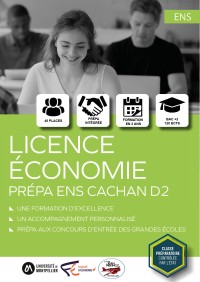
Bachelor's Degree in Economics, ENS Prep Track, 2nd Year
The preparatory program at the École normale supérieure (ENS), established in partnership with Lycée Mermoz in Montpellier under a cooperation agreement, has been in operation for several years. It is designed for a class of approximately forty students with high academic potential, who simultaneously pursue undergraduate coursework and prepare for the entrance exam for ENS Paris-Saclay (formerly ENS Cachan).
As part of this preparatory-university partnership, students in the preparatory program take certain courses at the university, where they take the corresponding exams. The grades earned at the university, combined with those from the preparatory program, allow students to complete their first and second years of the bachelor’s degree program.
The ENS D2 preparatory class thus offers an outstanding education in economics and management, designed for motivated students with a strong academic background, particularly in mathematics, up through the baccalaureate. It opens the door to a wide range of opportunities, both for further study—entrance exams for the grandes écoles, IEPs, and selective university programs—and for professional careers in the public and private sectors.
Mathematics for Economists 1
5 creditsLaw
4 creditsLANGUAGE SELECTION
2 creditsChoose one of the following two options:
English S1
2 creditsSpanish S1
2 credits
Business Economics
5 creditsPolitical Science
4 creditsHistory of Economic Events
5 creditsPrinciples of Economics
5 creditsOptional
Optional
LANGUAGE SELECTION
2 creditsChoose one of the following two options:
English S2
2 creditsSpanish S2
2 credits
Contemporary Economic Issues
4 creditsMathematics and Statistics for Economists - 2 -
5 creditsStatistics 1
5 creditsGeneral Accounting
Macroeconomics 1
5 creditsMicroeconomics 1
5 credits
Mathematics for Economists 3
5 creditsLANGUAGE SELECTION
2 creditsChoose one of the following two options:
English S3
2 creditsSpanish S3
2 credits
Macroeconomics 2
6 creditsSociology
4 creditsComputer Science S3
2 creditsMicroeconomics 2
6 creditsStatistics 2
5 creditsOptional
Optional
Organizational Management
5 creditsMicroeconomics 3
6 creditsMacroeconomics 3
6 creditsLANGUAGE SELECTION: English or Spanish
2 creditsOption 2, 4th Semester, 2nd Year, ENS
3 creditsOption 1, 4th Semester, 2nd Year, ENS
3 creditsStatistics 3
5 credits
S5 L3 ENS Course Selection
5 creditsChoose one of the following two options:
In-Depth History of Economic Events
5 creditsManagement Sciences
5 credits
Industrial Organization
LANGUAGE SELECTION
2 creditsChoose one of the following two options:
English S5
2 creditsSpanish S5
2 credits
Game Theory
4 creditsIntroduction to Econometrics
4 creditsEcological Transition for Sustainable Development
2 creditsEconomics of Growth
5 creditsIn-Depth Economic Policies 1
5 creditsOptional
Economic and Social Policy
5 creditsInternational Economics
4 creditsLANGUAGE SELECTION
2 creditsChoose one of the following two options:
English S6
2 creditsSpanish S6
2 credits
Data Analysis
3 creditsDatabase
4 creditsFinancial Analysis
4 creditsIn-Depth Economic Policies 2
5 creditsIn-Depth Analysis of Contemporary Economic and Social Issues
3 creditsOptional
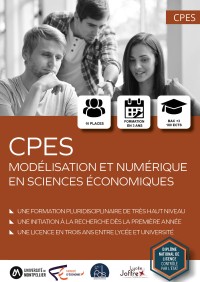
Bachelor's Degree in Economics, CPES Track - Modeling and Computation in Economic Sciences
The University of Montpellier and Lycée Joffre offer a CPES (Preparatory Program for Higher Education)in Modeling and Computational Methods in Economics. This selective three-year program, jointly organized by the high school and the university, leads to a bachelor’s degree and provides students with a sought-after dual set of skills, including an introduction to research beginning in the first year.
Students receive enhanced guidance from preparatory class instructors and university faculty members. The first year combines a core curriculum in computer science, mathematics, the humanities, and general education with specialized courses tailored to the student’s chosen track. Specialization occurs gradually, accompanied by projects and internships that introduce students to research.
The CPES program’s unique structure alternates between high school and university: in the first year, students spend four days at high school and one day at the university to delve deeper into coursework and work on projects. In the second year, time is divided equally between the two institutions, and in the third year, the bachelor’s degree program takes place entirely at the university, with additional courses designed to strengthen digital and computer skills.
Mathematics S1 (Joffre)
5 creditsModern Language S1 (Joffre)
2 creditsAdvanced Course in Microeconomics, CPES, Semester 1
4 creditsContemporary World Issues, Semester 1 (Joffre)
2 creditsComputer Science S1 (Joffre)
4 creditsAdvanced Course in Computer Science (CPES) - First Semester
2 creditsAdvanced CPES Mathematics S1
2 creditsGeneral Education S1 (Joffre)
2 creditsEconomics S1 (Joffre)
7 creditsOptional
Advanced CPES Mathematics S2 Course
2 creditsContemporary World Issues, Semester 2 (Joffre)
1 creditMath S2 (Joffre)
5 creditsComputer Science S2 (Joffre)
4 creditsCPES Advanced Course in Macroeconomics, Second Semester
4 creditsEconomics S2 (Joffre)
7 creditsCPES Economics Project, Semester 2
1 creditAdvanced CPES Computer Science Course, Second Semester
2 creditsGeneral Education S2 (Joffre)
2 creditsModern Language S2 (Joffre)
2 creditsOptional
Math S3 (Joffre)
2 creditsAdvanced CPES Mathematics S3
2 creditsEnglish CPES S3
1 creditAdvanced CPES Computer Science Course, Semester 3
2 creditsSupplementary Materials for General Mathematics, CPES S3
2 creditsAdvanced Course 1: Economics, CPES S3 (Statistics + Econometrics)
6 creditsComputer Science S3 (Joffre)
2 creditsEconomics S3 (Joffre)
6 creditsGeneral Education S3 (Joffre)
1 creditAdvanced Course 2: Economics, CPES S3 (Economics + Digital)
6 creditsOptional
General Education S4 (Joffre)
1 creditAdvanced CPES Computer Science Course, Semester 4
2 creditsMath S4 (Joffre)
2 creditsApplied Microeconomics
5 creditsAdvanced Course 1: Economics, CPES S4 (Statistics + Econometrics)
6 creditsAdvanced CPES Mathematics S4
2 creditsCPES Economics Project, Semester 4
3 creditsComputer Science S4 (Joffre)
2 creditsEnglish CPES S4
1 creditEconomics S4 (Joffre)
6 creditsOptional
Introduction to Econometrics
4 creditsGame Theory
4 creditsEnglish S5
2 creditsOptimization
3 creditsIndustrial Organization
Economy and Digital Technology
5 creditsOptional
Economy and Digital Technology
4 creditsOperations Research
3 creditsData Analysis
3 creditsDatabase
4 creditsEnglish S6
2 creditsL3 CPES S6 Project
5 creditsOptional
Admission
Admission Requirements
- For the first year of the bachelor's degree program: High school diploma or equivalent
- For the second year of the bachelor's degree program: First year of the bachelor's degree program or equivalent (subject to committee approval)
- For the third year of the bachelor's degree program: Second year of the bachelor's degree program or equivalent (subject to committee approval)
Registration Procedures
First Year of the Bachelor's Degree Program
If you are in your senior year of high school or wish to change your academic path to begin your first year of a bachelor’s degree program, you must submit an application through Parcoursup between January and March. Admission offers and responses to applicants will be sent out on a rolling basis between June and July.
2nd and 3rd years of the bachelor's degree program
To gain admission to the 2nd or 3rd year of a bachelor's degree program through course equivalency, the ecandidat application process is required.
economie.edu.umontpellier.fr/candidatures/candidatures-et-admissions/
Target Audience
High school and college students from the Montpellier School District, the Occitanie region, France, and around the world.
Tuition Fees
Tuition fees are set each year by the Ministry of Higher Education. They are accompanied by the Student and Campus Life Contribution (CVEC).
The entire program is free for students receiving scholarships.
Recommended Prerequisites
Possess the mathematical and statistical skills essential to economics and management
Economics courses frequently rely on mathematical modeling to better understand the problems being studied and to analyze the resulting findings in a logical manner. Furthermore, a large portion of careers in economics and business management rely on the analysis of numerical data.
Be able to apply written and oral communication skills and logical reasoning to support a conceptual argument
Economics courses require students to be able to present a structured argument—even a relatively simple one (a skill that is intended to be further developed in college)—and to reason about concepts. The bachelor’s degree program requires a certain capacity for abstraction, formal logic, and deduction.
Jobs in the field of economics often involve writing studies or reports that require structured reasoning, the ability to synthesize information, and strong writing skills.
Have a broad general knowledge
Economic analysis draws on current economic, political, and societal developments. Students must therefore be able to contextualize and understand the societal issues related to the topics covered during their studies.
Possess methodological and interpersonal skills that enable one to work independently and responsibly
In a bachelor's degree program, students take an active role in their education and success. In particular, they must be able to organize their work, seek out the resources available to them, and participate in group work sessions.
Have English language skills
There are many sectors of the economy where professional and academic documentation, as well as business relationships, rely on English. Proficiency in this language is therefore essential.
And then
Continuing Education
About 90% of students continue their studies after earning a bachelor’s degree (primarily in a master’s program). Most master’s programs in economics and finance in France are selective and require a bachelor’s degree in economics for admission.
The other students take civil service exams or enroll in business schools through the parallel admissions process. Very few students stop their studies after earning their bachelor’s degree.