


ECTS
60 credits
Duration
2 years
Training Structure
School of Economics
Language(s) of Instruction
French
Overview
The Bachelor’s Degree in Economics is a program that draws on knowledge of mathematics and statistics to analyze the decisions made by economic agents. The “Réussir” track is designed for students who do not meet the prerequisites for the standard Bachelor’s Degree in Economics program but whodemonstrate a strong motivation to succeed in this program.
It allows a group of 30 students to complete their first year of the economics bachelor’s degree in two years, with double the number of class hours in the core subjects of the economics bachelor’s program (mathematics, statistics, microeconomics, and macroeconomics). This program promotes gradual learning, enhanced academic support, and individualized student guidance.
At the end of the two-year “Réussir” track, students who have earned 60 ECTS credits will advance to the second year of their bachelor’s degree. They will then be able to continue their studies under conditions comparable to those of the traditional track.
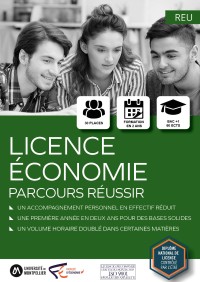
The Benefits of the Training Program
- PERSONALIZED SUPPORT
- A FIRST YEAR IN TWO YEARS
- TWO TIMES THE NUMBER OF FLIGHTS
Objectives
The program aims to strengthen students’ skills in the core courses of the bachelor’s degree in economics—particularly in mathematics, statistics, and economics—through an increased course load. It also aims to support students as they gradually develop their academic and career plans.
Expertise and Skills
A graduate with a bachelor's degree in economics
- Prepares and collects the information needed to compile economic analysis reports
- Prepares reports on studies: statistical or economic
- Monitors the progress of the studies assigned to him
- Maintains relationships with clients and his or her employer's contacts
- Analyzes practices and assesses their compliance with regulations
- Monitors economic legislation, procedures, and practices
- Helps implement management and decision-making tools
- Implements and uses applied tools for quantitative data management.
He has mastered
- Office software, information search techniques, information analysis and synthesis, communication techniques, and business English. (Source: RNCP)
- The bachelor's degree in economics equips students with analytical skills, perspective, and a broad outlook.
International Dimension
Starting in their second year, students can study at one of the 60 universities with which the School of Economics has partnerships through the ERASMUS+, inter-university exchange agreements, and CHARM-EU exchange programs.
Organization
Knowledge Assessment
The Bachelor’s Degree in Economics (Réussir track), which spans four years and eight semesters, is based on an assessment system designed to measure students’ learning progress in a gradual and comprehensive manner. At the end of each semester, the skills, competencies, and knowledge acquired in each course unit (UE) are assessed through one of two methods: continuous assessment or a final exam.
Continuous assessment allows for regular monitoring of student progress through various forms of evaluation: proctored exams, graded tutorials, presentations, projects, document analyses, and active participation in class. This approach encourages regular attendance, consistent work, and the gradual acquisition of skills.
The final exam, on the other hand, consists of a written or oral test administered at the end of the semester. Its purpose is to assess the student’s overall mastery of the concepts taught and their ability to apply their knowledge in a structured and in-depth manner.
Depending on the learning outcomes or learning objectives, some units may combine both assessment methods. These approaches ensure that assessments are fair, diverse, and tailored to the nature of the course.
Special Features
Students with disabilities, young entrepreneurs, and elite athletes can receive personalized support.
This may take the form of academic accommodations, pedagogical adjustments, or specific rights, in order to enable students to best balance their personal or professional commitments with their university studies. Depending on the situation, these measures may include an adapted class schedule, modified assessment procedures, attendance accommodations, individualized support, or dedicated support services.
Internships, supervised projects
Internship | Possible |
|---|---|
Duration of the internship | A maximum of 924 hours, or 6 months |
Internship Abroad | Possible |
A true immersion in the professional world, it allows students to apply the knowledge they’ve acquired in class, discover how organizations operate, and compare theory with practice. To get the most out of it, thorough preparation is essential: learn about the host organization, define your goals, draw on what you’ve learned, and prepare for professional demands.
During the bachelor's degree program, internships are available but optional. They must be related to the program of study.
The internship may begin after the second-semester exams or take place during university breaks. In any case, it must end no later than August 31.
Program
The Bachelor of Arts in Economics, "Réussir" track, is a 2-year program consisting of 4 semesters
First Year: Earn 30 ECTS
Second Year: Success Bis 30 ECTS
Upon completion, students who earn these 60 ECTS credits advance to the second year of the bachelor's degree program in Economics
Optional
Business Economics
5 creditsMath Remedial Course
2.5 creditsVoltaire Certification
English
2 creditsPrinciples of Economics
5 creditsStatistics
2.5 credits
Optional
Statistics
2.5 creditsMacroeconomics 1
2.5 creditsMathematics for Economists
2.5 creditsGeneral Accounting
Voltaire Certification
English
1 credit
Mathematics 2
2.5 creditsPolitical Science
4 creditsLaw
4 creditsHistory of Economic Events
5 creditsMicroeconomics
2.5 creditsOptional
Admission
Admission Requirements
- For the first year of the bachelor's degree program (Réussir track):High school diploma or equivalent
Registration Procedures
First Year of the Bachelor's Degree Program
If you are in your senior year of high school or wish to change your academic path to begin your first year of a bachelor’s degree program, you must submit an application through Parcoursup between January and March. Admission offers and responses to applicants will be sent out on a rolling basis between June and July.
economie.edu.umontpellier.fr/candidatures/candidatures-et-admissions/
Target Audience
High school and college students from the Montpellier School District, the Occitanie region, France, and around the world.
Tuition Fees
Tuition fees are set each year by the Ministry of Higher Education. They are accompanied by the Student and Campus Life Contribution (CVEC).
The entire program is free for students receiving scholarships.
Capacity
40
Recommended Prerequisites
Have a strong interest in economics
The “Réussir” track is designed for students who are passionate about economics but whose foundation in quantitative subjects (particularly mathematics) is deemed insufficient to enter the standard track directly. A strong motivation to commit to a demanding two-year program is the primary criterion for success.
Be willing to strengthen and develop quantitative skills
Students must be prepared to commit to double the number of class hours in these core subjects. The goal is to rebuild a solid foundation for rigorously analyzing the decisions of economic agents.
Enroll in an intensive, personalized support program
Unlike the traditional track, which requires immediate independence, students in thisprogramcan seek academic guidance. This involves regular attendance in small classes (approximately 30 to 40 students) and active participation in tutoring and follow-up sessions with the assigned instructor.
Ability to work as part of a team and in small groups
Learning within a small cohort requires interpersonal skills to take full advantage of the group dynamics and the methodological support provided.
And then
Continuing Education
Upon completion of the two-year “Réussir” program, students who earn these 60 ECTS credits advance to the second year of the bachelor’s degree program in Economics.