


Target level of study
Master's degree
ECTS
120 credits
Duration
2 years
Training structure
Faculty of Economics
Language(s) of instruction
French
Presentation
The Master's degree in Economics from the Faculty of Economics in Montpellier trains specialists capable of analyzing and supporting contemporary economic transformations, particularly in the fields of public policy, management, and production systems. It addresses today's major societal challenges (ecological, energy, digital, health, and food transitions).
The proposed courses are based on a recognized research environment, in close collaboration with the ART-Dev, CEE-M, and MRE teams, and are part ofISITE's research areas: Feeding, Protecting, and Caring, also incorporating contributions from digital technology and behavioral sciences.
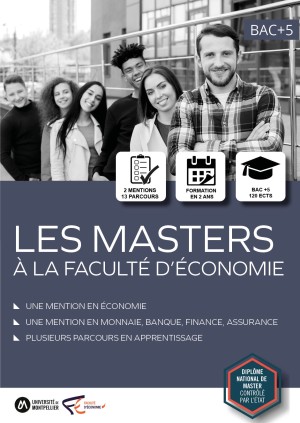
The advantages of the training program
- SOLID AND VERSATILE TRAINING
- SUITABILITY FOR THE WORKPLACE
- DIVERSITY OF BACKGROUNDS
Objectives
The Master's degree in Economics aims to:
-
Train economists capable of analyzing economic, social, environmental, and technological transitions;
-
Develop skills in designing, evaluating, and steering public policies and organizational strategies;
-
Understanding the challenges related to food, the environment, energy, health, and digital technology;
-
Integrate contributions from research in economics, environmental economics, development economics, digital economics, and behavioral economics;
-
Prepare students for careers in the public and private sectors, as well as for doctoral studies.
Know-how and skills
Know-how
-
Analyze economic issues related to major transitions (ecological, energy, digital, health)
-
Mobilizing the tools of applied economic analysis
-
Designing and evaluating public policies and collective action mechanisms
-
Using and interpreting economic data
-
Write summary notes and reports to aid decision-making
-
Present and discuss analysis results
Skills
-
Analysis and understanding of contemporary economic transformations
-
Support for public and strategic decision-making
-
Critical thinking and ability to synthesize information
-
Autonomy in conducting projects and studies
-
Teamwork and interaction with various stakeholders
-
Adaptability to diverse professional contexts
International dimension
Starting in their second year, students can spend a year (two semesters) at one of the 60 universities with which the Faculty of Economics has partnerships through the ERASMUS+ exchange programs, inter-university agreements, and CHARM-EU.
Organization
Special facilities
Students with disabilities, young entrepreneurs, and high-level athletes can benefit from personalized support.
This may take the form of study arrangements, educational adaptations, or specific rights, in order to enable them to best balance their personal or professional constraints with their university education. Depending on the situation, these measures may include an adapted schedule, adjusted assessment methods, attendance facilities, individualized monitoring, or dedicated support services.
Open alternately
Apprenticeships are based on the principle of alternating between academic and practical training at university and acquiring skills with an employer. The pace of this alternation varies depending on the program, but follows a schedule established in advance.
The apprenticeship contract is a special employment contract that allows students to benefit from dual status: student and full-time employee of the company.
The Master's degree in Economics offers several tracks that allow students to pursue a Master 2 apprenticeship, combining university education and professional experience in order to facilitate entry into the job market.
- Energy Efficiency
- Digital Economy
- Governance of Companies and Territories in Transition
Internships, supervised projects
Internship | Possible |
|---|---|
Duration of the internship | Maximum 924 hours, or 6 months |
Internship abroad | Possible |
A true immersion in the professional world, it allows students to apply the knowledge they have acquired in class, discover how organizations work, and compare theory with practice. To get the most out of it, serious preparation is essential: learning about the host organization, defining your objectives, mobilizing your skills, and preparing for professional demands.
All Master's programs offer the possibility of doing an internship.
In Master 1, internships are possible and optional. They must be related to the program.
The internship may begin at the end of the second semester exams or be completed during university vacation periods. In all cases, it must end no later than August 31, regardless of whether the student is enrolled in a Bachelor's degree, Master's degree, or University Diploma program.
In Master 2, the internship is mandatory.
The start date is set in agreement with the academic supervisor, generally between February and March, in order to fit in with the training schedule and the requirements of the final thesis. Regardless of the period chosen, the internship mustend no later than September 30.
Program
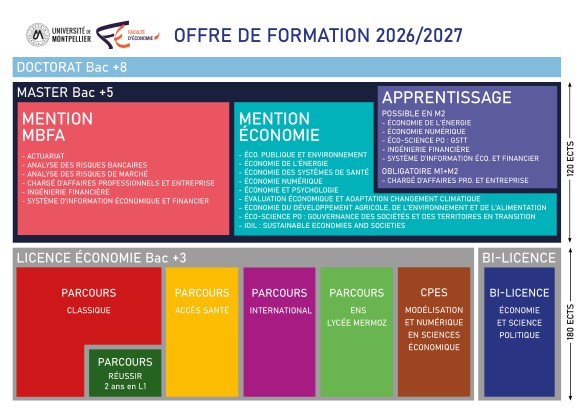
Select a program
Agricultural Development, Environment, and Food Economics
The Agricultural Development, Environment, and Food Economics program is designed for students who wish to acquire research-based training, mainly focused on economic analysis, while also incorporating complementary courses in management sciences and economic sociology.
This Master's program aims to train students to perform roles that require autonomy, initiative, and a thorough understanding of economic reasoning. It focuses on teaching the fundamental theoretical and methodological knowledge of contemporary economic analysis.
Significant emphasis is placed on the use of advanced modeling and quantification techniques, as well as approaches derived frominstitutional economics and management sciences. Thanks to the various specializations offered, the program also provides students with in-depth expertise applicable to many sectors of the economy, paving the way for both academic research and careers in consulting and analysis.
Choose one of two options:
Optional
Agricultural economics and agricultural policy
4 creditsProject management and financial evaluation
3 creditsEconometrics
Introduction to R software
1 creditEnvironmental economics
PIR
Public economics
3 creditsSurvey methods
Stata
Choose one of two options:
Optional
Corporate social responsibility
4 creditsEconomics of risk and uncertainty
Excel VBA
3 creditsNatural resource governance
4 creditsEconometrics of qualitative variables
PIR
5 creditsData analysis
3 creditsBehavioral economics
EU1 Core curriculum
3 creditsUE3 Specialty Course 1
Choose 3 to 4 out of 4
UE2 Methodology courses
Choose 3 out of 4
UE4 Specialty Course 2
Choose 3 out of 5
Memory
22 creditsOPTION 1
10 creditsChoose 2 out of 4
Seminar 1 (Supagro)
2 creditsSeminar 3
2 creditsSeminar 4
2 creditsSeminar 2 (Supagro)
2 credits
Research support tutorial (Supagro)
Energy Efficiency
Created in 1992 by Professor Jacques Percebois, the Energy Economics program at the University of Montpellier has been training applied economists specializing in energy issues for over thirty years. It provides students with the skills they need to understand the challenges and anticipate the consequences of the structural transformations facing the energy sector: decarbonization and decentralization of production methods, changes in market models and energy pricing, development of new energy uses, etc.
The Master's program maintains close ties with public and private stakeholders in the energy sector, who regularly participate in conferences, professional seminars, and consulting projects, enabling students to apply their skills to meet the sector's specific needs.
Choose one of two options:
Optional
Introduction to SAS
Project management and financial evaluation
3 creditsEconometrics
Energy saving 1
2 creditsIntroduction to R software
1 creditNetwork regulation
Environmental economics
PIR
Public economics
3 creditsSurvey methods
Energy saving 2
3 creditsIndustrial organization
4 creditsNetwork economics
3 creditsEnergy geopolitics
Excel VBA
3 creditsEconometrics of qualitative variables
PIR
5 creditsData analysis
3 creditsChoose one of two options:
Optional
Electricity savings
4 creditsEnergy and development
4 creditsIntroduction to Energy Physics
3 creditsSmart grids, energy, and mobility
3 creditsTransportation, energy, and environment
4 creditsFinancing renewable projects
4 creditsLegal framework for renewables
3 creditsEnglish
2 creditsClimate and energy transition economics
3 credits
Energy market design
3 creditsSeminars/Conferences and Consulting Projects
4 creditsLow-carbon innovation
3 creditsMemory
15 creditsEnergy law and market regulation
2 creditsEnergy efficiency
3 credits
Digital Economy
The Digital Economy Program offers enhanced skills in the organization of telecommunications, Internet, and media markets, digital business strategies, and regulatory frameworks applicable to digital markets.
This program involves professors and professional lecturers specializing in digital economics. The courses and seminars provide a wide range of technical skills, particularly in data processing and analysis, as well as in-depth knowledge of the strategies implemented by digital players: traditional telecommunications, Internet, and media companies, online service platforms, and social networks.
For more information about the program: watch the Master's presentation video on the Faculty of Economics YouTube channel:
Digital transformation of the economy
Econometrics
Introduction to R software
1 creditNetwork regulation
Data mining and big data
Computer tools for the Web 1
4 creditsPIR
Law and economics
2 creditsData warehouse
Choose one of two options:
Optional
IT tools for Web 2.0
4 creditsEconomics of innovation and intellectual property
3 creditsIndustrial organization
4 creditsNetwork economics
3 creditsInvestment choices
2 creditsDigital business model
3 creditsEconometrics of qualitative variables
PIR
5 creditsChoose one of two options:
Optional
Professionalization tools 1
2 creditsSmart grids, energy, and mobility
3 creditsPricing strategy
3 creditsComputer processing of data
3 creditsBusiness English & Managerial Communication
2 creditsIndustrial economics
3 creditsPromoting innovation
2 creditsInternet and platform economy
3 creditsDigital media economics
3 creditsCompetition policy
3 creditsApplied econometrics
3 credits
Competition law
2 creditsInternship report
25 creditsProfessionalization tools 2
3 credits
Public Economics and Environment
COURSE PRESENTATION MEETING:
The meeting will take place on February 7, 2024, at 1 p.m. in Lecture Hall 319.
You can watch this meeting via video conference:
Faced with growing pressure from human activities on the environment, our societies are called upon to resolve difficult trade-offs. These involve explicit costs and diffuse damage, but also benefits that are unevenly distributed among actors and generations. Economic analysis aims to assist public, associative, and private decision-making in this area. This program provides in-depth knowledge of environmental and natural resource economics, as well as public economics, i.e., the economic study of collective choice processes. These are two complementary branches of economics, on the basis of which economists can formulate proposals that are both economically effective and politically acceptable. The program is supported by a team of professors and researchers specializing in these issues, who are members of the Montpellier Center for Environmental Economics.
Corporate social responsibility
4 creditsExcel VBA
3 creditsEconomics of risk and uncertainty
Natural resource governance
4 creditsEconometrics of qualitative variables
PIR
5 creditsData analysis
3 creditsBehavioral economics
Optional
Choose one of two options:
Economics of biodiversity and natural resources
3 creditsChoice experiment
Public economic calculation
3 creditsEnvironmental economics and policy
2 creditsSocial incentives and preferences
3 creditsTopics in experimental and behavioral economics
3 creditsSocial Dilemmas
3 creditsEnvironmental information and labels
3 creditsStatistical method
3 creditsEvaluation of non-market effects
3 credits
Taxation and the environment
2 creditsGlobalization and the environment
2 creditsPolitical economy of environmental policy
2 creditsHealth and environment
2 creditsEconomics of justice and fairness
Research or internship thesis
13 creditsCircular economy
3 creditsGame Theory 2
3 credits
Economics and Psychology
A course designed to train experimentalists/behavioral scientists capable of managing an experimental project from its conception to its practical implementation, whether in the laboratory or in the field.
Students will be involved in experimental projects and will be encouraged to carry out their own projects. The training is both theoretical and practical.
EU Econometrics M1 ECOPSY
Introduction to R software
1 creditEconometrics Ecopsy
2 credits
Experimental Economics 1
2 creditsGame theory
Econometrics
PIR
Survey methods
UM3 research methodology
Stata
Choose one of two options:
Economy upgrade
3 creditsPsychological upgrade (UM3)
3 credits
Optional
Choose one of two options:
Choice experiment
Cognitive biases 1 (UM3)
3 creditsSocial incentives and preferences
3 creditsTopics in experimental and behavioral economics
3 creditsSocial Dilemmas
3 creditsResearch Methodology 2 (UM3)
4 creditsEnglish (UM3)
3 creditsStatistical method
3 creditsZ-Tree
3 creditsExperimental design (UM3)
3 credits
Project (Thesis)
15 creditsNonparametric tests
2 creditsEconomics of justice and fairness
Topics in social psychology (UM3)
3 creditsCognitive biases 2 (UM3)
2 creditsGame Theory 2
3 creditsTopics in neuroscience and cognitive psychology (UM3)
3 credits
Health Systems Economics
The Health Systems Economics program is part of the Master's Degree in Economics offered by the Faculty of Economics, in the field of Law, Economics, and Management.
The program focuses on economic issues in healthcare systems. An aging population and technical advances in healthcare are leading to major changes in the organization of care and the financing of healthcare systems. These changes require a more integrated definition of patient pathways and trajectories and the emergence of new players and tools for regulating healthcare provision.
Choose one of two options:
Introduction to SAS
Project management and financial evaluation
3 creditsDigital transformation of the economy
Econometrics
Introduction to R software
1 creditPIR
Law and economics
2 creditsSurvey methods
Healthcare and social protection system
5 creditsOptional
Optional
Choose one of two options:
Economics of innovation and intellectual property
3 creditsIndustrial organization
4 creditsHealthcare system regulation
Excel VBA
3 creditsEconometrics of qualitative variables
PIR
5 creditsData analysis
3 credits
Double difference methods
3 creditsHealth and Digital Technology
3 creditsHealth and territories
2 creditsEvaluation of public policies
3 creditsMultidisciplinary primary care and care pathways
2 creditsMeasuring well-being in assessment methods
2 creditsAdvanced SAS
2 creditsEnglish
2 creditsEconomic assessment and market access
2 creditsPrinciples of medical-economic evaluation
3 creditsEvaluation of non-market effects
3 creditsIntroduction to epidemiology and clinical research methods
3 credits
Economic Assessment and Climate Change Adaptation
Around a central core of evaluation methods, various themes have been introduced over time, notably to address the issues of consultation and policy acceptability, as well as behavioral economics to understand endogenous incentives in the field of environmental policy. In addition to developments related to the introduction of sustainable development and integrated and participatory policies, the urgency of climate change issues has recently generated new needs.
The M1 courses are largely shared with the Public Economics and Environment track, as well as with the major or several tracks in terms of econometrics and multivariate analysis tools. In particular, the M1 program includes an application exercise spread over two semesters and common to the entire major, aimed at empowering students to analyze an issue and make operational use of econometric tools. This exercise, known as PIR (individual research project), has been successfully implemented for the past five years.
Specific modules on adaptation and assessment are integrated into the M2 program, with significant overlap with the Health Systems Economics track for assessment courses and the EPE, Energy Economics, and Ecodéva tracks for environmental issues.
Presentation of the training course on the Faculty of Economics' YouTube channel:
Choose one of two options:
Optional
Introduction to SAS
Project management and financial evaluation
3 creditsEconometrics
Introduction to R software
1 creditDevelopment economics
4 creditsEnvironmental economics
PIR
Public economics
3 creditsSurvey methods
Optional
Choose one of two options:
Cognitive functions (UM3)
Corporate social responsibility
4 creditsEnergy geopolitics
Economics of risk and uncertainty
Excel VBA
3 creditsNatural resource governance
4 creditsEconometrics of qualitative variables
PIR
5 creditsData analysis
3 creditsBehavioral economics
Double difference methods
3 creditsPublic economic calculation
3 creditsTopics in experimental and behavioral economics
3 creditsEvaluation of public policies
3 creditsOutlook and climate
3 creditsMeasuring well-being in assessment methods
2 creditsEnvironmental information and labels
3 creditsStatistical method
3 creditsClimate and energy transition economics
3 creditsEvaluation of non-market effects
3 credits
Choice experiment
Memory
15 creditsLow-carbon innovation
3 creditsPolitical economy of environmental policy
2 creditsComputer graphics
Consultation method
Response to calls for tenders
Examples: Energy transition roadmap and cost analysis
Vulnerability of territories
4 creditsModeling support in the face of climate uncertainty
2 credits
Governance of Companies and Territories in Transition
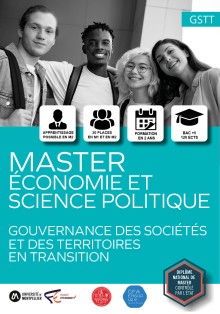
The dual-discipline Master's degree in Economics and Political Science, " Governance of Societies and Territories in Transition (GSTT)," is an extension of the dual-degree program in economics and political science created in 2021 atthe University of Montpellier. It offers students a demanding and in-depth education in these two disciplines and is aimed at those with a solid background in social sciences, particularly economics and political science. This program aims to prepare students for emerging professions or sectors undergoing profound change.
The program has been designed in close connection with the major contemporary issues that are transforming societies and territories, such as energy and ecological transitions, transport and mobility issues, health, digital technology, as well as democratic and cultural transitions and institutional developments.
Unique in France, this multidisciplinary Master's program is based on a balanced collaboration between the economics and political science teams atthe University of Montpellier.
Optional
EU Public Action and Governance
4 creditsEnergy saving 1
2 creditsComputer science applied to projects
2 creditsEU Quantitative Studies
Economic analysis of public policies
4 creditsMethodology of the thesis
Artificial intelligence and societies
3 creditsEU Political Sociology of Gender
2 creditsEnglish
Environment and Policy (ST)
Economic analysis and project finance
4 credits
Optional
EU Local government
3 creditsMethodology of the thesis
EU Environmental law
2 creditsHealthcare system regulation
Econometrics of qualitative variables
EU New security challenges
3 creditsMemory
4 creditsEnergy geopolitics
English
2 creditsTerritorial economy
2 creditsEconometrics of qualitative variables
EU Migration, societies, and territories
2 creditsMedia and society
2 creditsComparative Politics (ST)
Territories and inequalities
4 creditsDigital economics and policy
3 creditsGovernance of metropolitan areas
4 creditsCultural policies
4 creditsSustainable transport and mobility
3 creditsEnvironment and health
2 creditsNatural resource governance
3 creditsEnergy and environmental transition
3 credits
Optional internship for professional integration
Choose one of two options:
Internship
20 creditsMemory
20 credits
Collective project
8 creditsSupervised project
2 creditsOptional
IDIL - Sustainable Economies and Societies
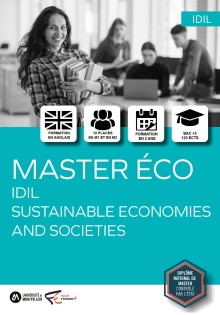
The Sustainable Economies and Societies program is part of the IDIL (Interdisciplinary In Lab) graduate program atthe University of Montpellier, which brings together excellent courses based on research andinterdisciplinarity. Taught in English at the Faculty of Economics, this master's program aims to train students to analyze and support economic and social transformations related to the major challenges of sustainability.
Based on the thematic pillars of Feeding, Caring, and Protecting, the program offers an interdisciplinary approach combining economics, social sciences, and public policy. The "In-Lab" teaching method places students at the heart of research projects conducted in collaboration with laboratories and socio-economic actors, encouragingexperimentation and multidisciplinary teamwork.
Open to an international audience, the program prepares students for doctoral studies and careers inanalysis, consulting, and project management related to sustainable development policies,innovation, and territorial and societal transitions.
Mediterranean Farming System Design for a Sustainable Food System (MIDAS)
 The MIDAS course follows on from intensive training provided since 2010 by CIHEAM-IAMM in partnership with several Mediterranean agricultural research and teaching institutes and with the global FSD (Farming System Design) network. More than 300 international participants have been trained in this context. Until now, these intensive courses have been designed to train young scientists in the analysis and evaluation of the sustainability of agricultural systems using integrated approaches. The originality of the MIDAS program, which will draw on several teaching aids and the network of researchers mobilized as part of the intensive training courses, will be to evolve to address issues related to the design of agricultural systems based on food and climate change challenges and to give prominence to the role of diversity (in terms of cropping systems, farms, and actors in the field) in improving the resilience of these systems' food-producing function in the face of climate change and market uncertainties.
Territorial Agricultural Development, Environment, and Modeling (DATEM)
This course responds to a request from the Lebanese Ministry of Agriculture and the Faculty of Agronomy at the Lebanese University to train engineers in the new challenges already facing Lebanon: resource scarcity, climate change, and market instability marked by significant regional tensions. Two important components relate to skills that have been lacking in Lebanon until now: (i) modeling agricultural systems to design systems that are resilient to climate uncertainties and the socio-economic context, and (ii) integrating environmental issues into the evaluation of agricultural system performance. This course is particularly important for students from the southern Mediterranean (and more specifically Lebanon) as it is unique in this field (multi-criteria analysis through modeling, territorial agricultural development, environment). This program is designed to respond to the restructuring of the agricultural sector in the southern Mediterranean, with the establishment of regional extension centers, and to better match the profiles of future engineers working for ministries of agriculture and local authorities. >> Learn more
Admission
Admission requirements
- For Master's 1: Holder of or currently pursuinga bachelor's degree (or equivalent, three years of higher education) in economics or a similar field, recognized in France or Europe.
- For the Master 2: Have completed at least 4 years of higher education (Bac +4 / 240 ECTS) in fields related to economics or similar. A strong academic record and, in some cases, professional experience are valued.
Registration procedures
First year of master's degree
If you wish to apply for admission to Master 1, you must submit your application on the Mon Master platform .
Second year of master's degree
To gain equivalent access to the second year of the master's program, the ecandidat procedure is mandatory.
economie.edu.umontpellier.fr/applications/applications-and-admissions/
Target audience
Students from the Montpellier Academy, the Occitanie region, France, and internationally
Tuition fees
Tuition fees are set each year by the Ministry of Higher Education. They are accompanied by the Student and Campus Life Contribution (CVEC). Both are exempt for students receiving scholarships.
Recommended prerequisites
A good level inmicroeconomics, macroeconomics, mathematics, statistics, and econometrics is essential. Depending on the desired career path, certain options may be valued.
And after
Continuing education
Master's degree graduates can continue their studies, particularlyin economics, in France or abroad, especially those who are interested in research or higher education. Additional specialized training (university degrees) may also be considered depending on career plans.
Professional integration
The study and support of societal transformations, which are central to the program's focus, are a common thread running through all courses.
This track opens up numerous career opportunities in a variety of fields and contexts. Career opportunities include management positions in local and regional government, national and regional government departments, NGOs and associations, and international organizations, particularly those within the United Nations system (World Bank, FAO, UNDP, UNEP, IMF, UNIDO, etc.).