


Training Structure
College of Sciences
Language(s) of Instruction
French
Overview
Objectives
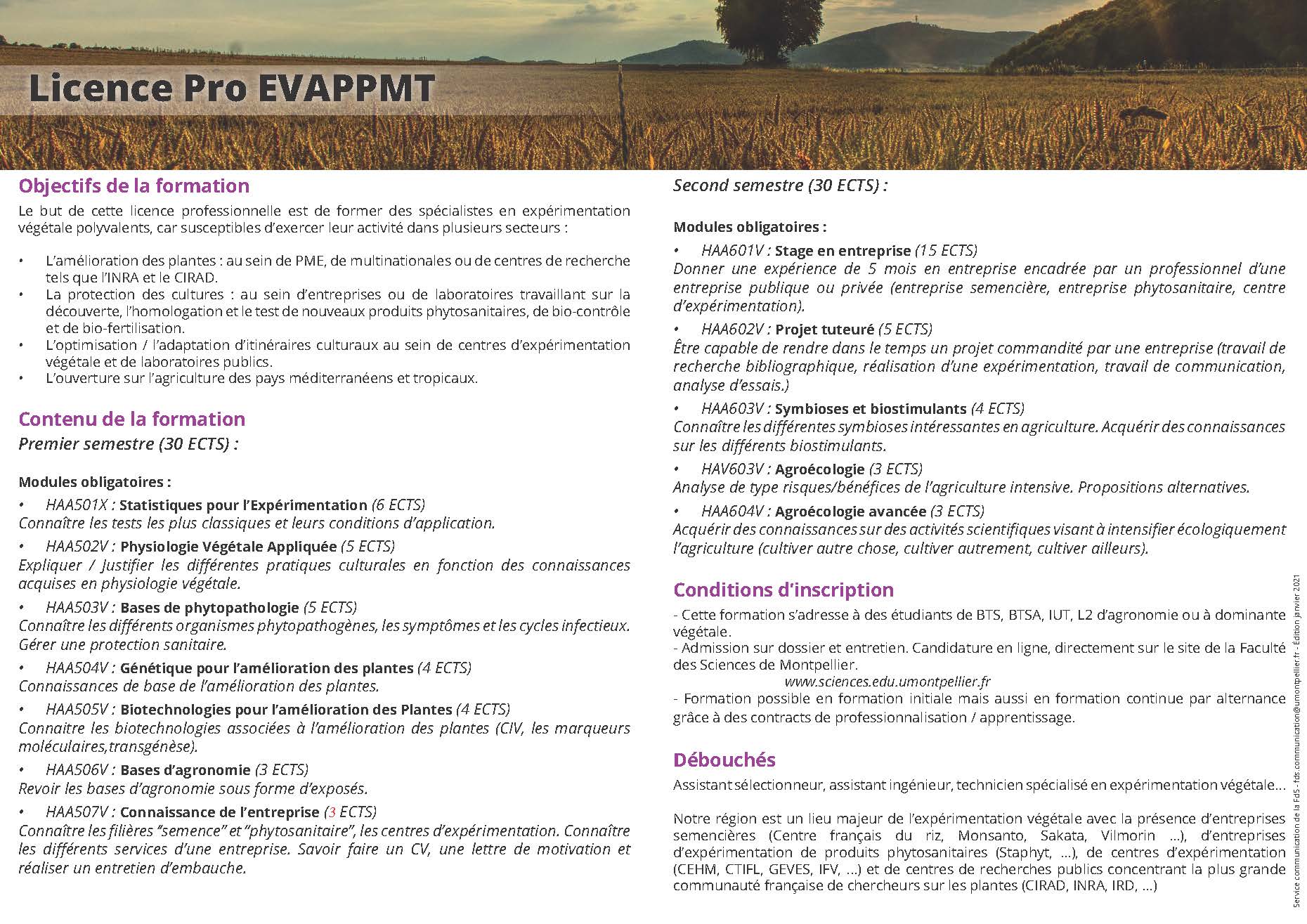
Agriculture faces many challenges: providing food and renewable materials, serving as a source of income for farmers, and delivering ecosystem services—all within a scientific framework. The challenge is a significant one and can only be met by seeking solutions in a wide range of scientific fields: genetics, agronomy, biotechnology, ecology, modeling, robotics, and more. Agriculture therefore needs technicians capable of conducting experiments that span a wide variety of scientific and technical fields...
Program
Genetics for Plant Breeding
4 creditsBiotechnology for Plant Breeding
4 creditsFundamentals of Agronomy
3 creditsStatistics for the Experiment
6 creditsBusiness Knowledge
3 creditsApplied Plant Physiology
5 creditsFundamentals of Plant Pathology
5 credits
Fundamentals of Agroecology
3 creditsSupervised Project
5 creditsInternship
15 creditsAdvanced Agroecology
3 creditsSymbiosis and Biostimulants
4 credits
Genetics for Plant Breeding
Level of Education
Bachelor's degree (BAC +3)
ECTS
4 credits
Training Structure
College of Sciences
In the first part, this module aims to provide a general overview of plant breeding. A historical analysis of plant breeding is conducted to stimulate reflection on the evolution of the pace of genetic progress, ideotypes, and the profession of plant breeder.
In the second part, the various methodologies for improving germplasm and for breeding are described. Traditional breeding strategies such as backcrossing, recurrent selection, pedigree selection, and diallel tests are described in detail. Part of the course is also devoted to providing tools for analyzing and monitoring these breeding strategies (e.g., AGC/ASC calculations, heritability calculations, and statistics for evaluating a genotype). These theoretical lectures are further illustrated by presentations given by various professionals in the field of plant breeding.
Examples of interventions:
- Arnaud Boisnard (CFR): Course on Rice Selection in the Camargue
- Frederic Bakry (CIRAD): Course on Banana Breeding
- André Clement-Demange (CIRAD): Course on Rubber Tree Breeding
- Vincent Gensollen (GEVES): Visit to GEVES Montpellier
Conservative selection experiments are covered in the third part of the course. The various seed production methods and ways to improve seed production and quality are discussed with input from professionals.
Examples of interventions:
- Sophie Colénot (Bayer): Experience in Seed Production
- David Martinez (Clause Hm) Seed Quality Testing
In addition to the courses, students must give a presentation in which they develop a breeding program for a crop species. To prepare for this presentation, students must apply what they have learned in class and also consult with plant breeders.
Biotechnology for Plant Breeding
Level of Education
Bachelor's degree (BAC +3)
ECTS
4 credits
Training Structure
College of Sciences
This module begins with a refresher on molecular and cellular biology. The lectures then explore the impact of biotechnology on genetic progress. Finally, the various biotechnologies useful in plant breeding are described. These biotechnologies are classified into two groups: (i) those that enable the creation or propagation of beneficial mutations (mutagenesis, polyploidization, haplo-diploid methods, in vitro culture, transgenesis, genome editing, etc.) and (ii) those that promote the recombination of mutations (interspecific crosses, somatic hybridization, molecular marking, etc.). These courses are supplemented by presentations given by professionals.
Examples of courses created by professionals:
- Frederic BAKRY (CIRAD) Banana Biotechnology
- Léo HERBERT (CIRAD): CRISPR in grapevines and rice
- Sébastien TISNE (CIRAD): Biotechnology for Oil Palm Breeding
9 hours of hands-on work in in vitro cell culture (tobacco, potato, carrot, etc.) and microsatellite genotyping and QTL mapping on a biparental rice population.
Fundamentals of Agronomy
Level of Education
Bachelor's degree (BAC +3)
ECTS
3 credits
Training Structure
College of Sciences
This course is offered to students in the third year of the professional degree program “Plant Experimentation for the Improvement and Protection of Mediterranean and Tropical Plants.” Its objective is to introduce (or review, depending on the students’ course of study) the basic concepts of agronomy concerning (1) how the “plant” system functions in interaction with its environment and ecosystem, (2) soil parameters that influence plant growth, and (3) climate parameters that influence crop development and yield. Certain key topics (plant pathology, soil ecology, experimentation, irrigation, and yield modeling) are then explored in greater depth through specialized lectures. Students develop their understanding of these concepts and the relationships between them through plant experimentation, including the analysis of articles and case studies.
Statistics for the Experiment
Level of Education
Bachelor's degree (BAC +3)
ECTS
6 credits
Training Structure
College of Sciences
After reviewing statistical inference (estimation, tests for one or two populations), the course introduces the classical experimental designs used in agronomy for one or two factors and focuses on the standard statistical approaches associated with them (ANOVA, fixed-effects Gaussian linear model). Emphasis is placed on the conditions underlying the application of statistical methods, the validation of the statistical models used, and the interpretation of software output. The R software, using the Rcommander interface, is used for statistical analysis.
Business Knowledge
Level of Education
Bachelor's degree (BAC +3)
ECTS
3 credits
Training Structure
College of Sciences
The purpose of this module is to provide some tools for integrating into a company. It is organized as follows:
Lectures / Lab Sessions
- Franc-Christophe BAURENS (CIRAD) – Safety Rules (Greenhouse-Laboratory)
- Ludovic MARIN (UM-Staps) – Postures at Work: CM and Heavy Lifting (Practical Training in the Gym)
Company visits. Company visits are divided into two parts.
- Mock Hiring Exercise. Fifteen days before the visit, students receive a job offer from the company. Students have one week to respond (resume and cover letter). On the day of the visit, a member of the company’s recruitment team conducts a debriefing on the resumes and cover letters.
- Tour of the facilities.
The companies visited are:
- Bayer (Nîmes). An example of a seed company. From variety development to seed distribution.
- Staphyt (Marsillargues). An example of a plant research company. Description of the trial process from start to finish. Discussion of the roles of research technician and research manager.
- CTIFL (Balladran). Example of a technical center. Description of the technical center’s activities and a tour of the experiments being conducted in the greenhouses.
- CIRAD (Montpellier). Tour of the greenhouses and descriptions of the experiments being conducted there.
Applied Plant Physiology
Level of Education
Bachelor's degree (BAC +3)
ECTS
5 credits
Training Structure
College of Sciences
This course is offered to students in the third year of the professional bachelor’s program “Plant Experimentation for the Improvement and Protection of Mediterranean and Tropical Plants.” Its objective is to provide students with the conceptual foundations of plant physiology in order to understand agricultural practices. The following major topics in plant physiology will be covered, highlighting the contributions of functional biology to a detailed understanding of these processes at the molecular and cellular levels:
- Water management and sustainable irrigation,
- N, P, and K Nutrition, Inputs, and Agroecology,
- C3 and C4 photosynthesis;
- The Relationship Between Water and Carbohydrate Intake,
- Vegetative growth of the stem and roots,
- Flowering, pollination, seed and fruit development
- The Main Plant Hormones
Laboratory exercises will be conducted to teach students how to design an experimental protocol for studying a physiological process
Fundamentals of Plant Pathology
Level of Education
Bachelor's degree (BAC +3)
ECTS
5 credits
Training Structure
College of Sciences
Through lectures, tutorial sessions, and lab work, students will explore various aspects of phytopathological experiments:
- Understand the various plant pathogens (viruses, viroids, phytoplasmas, bacteria, fungi, nematodes, insects, weeds)
- Understand how plant-pathogenic microorganisms function.
- Understanding Plant Defense Mechanisms Against Phytopathogenic Microorganisms
- Understand the mechanisms by which plant-pathogenic microorganisms evade resistance genes and plant protection products.
- Gain a basic understanding of epidemiology.
Many researchers from CIRAD, INRA, IRD, and Supagro are participating in this module.
During the lab sessions, a pathology experiment is conducted (pathogen culture, plant culture, inoculation, symptom identification, pathogen counting, catalase activity)
Fundamentals of Agroecology
Level of Education
Bachelor's degree (BAC +3)
ECTS
3 credits
Training Structure
College of Sciences
After defining intensive agriculture and analyzing its risks and benefits, this module will enable students to reflect on various possible approaches to transitioning agriculture toward an agroecological model. Examples such as biopesticides, ecological intensification, and soil management will be explored. A field trip to a company committed to sustainable agriculture is also organized. The site visited varies from year to year depending on student preferences and company availability. Examples of field trips conducted as part of this module include visits to Bayer, Vilmorin, Geves, CTIFL, and sudExpé.
Bachelor's degrees.
Students will be asked to present a project or business plan that develops innovative proposals to advance farming practices or any other use of plant products in order to reduce environmental impact.
Supervised Project
ECTS
5 credits
Training Structure
College of Sciences
In this module, students work in groups of 3 or 4 on a real-world project proposed by faculty researchers or researchers from private companies, thereby applying their theoretical knowledge in practice. The project is carried out in two stages.
The first phase takes place during the first semester. It involves preparing an experiment from scientific, statistical, technical, and financial perspectives. This work will be tracked throughout the first semester through a series of oral presentations in the form of “lab seminars” on various topics:
- Seminar 1: Literature review on the topic of their supervised project.
- Seminar 2: Journal Club, featuring a detailed analysis of a key article related to the topic of their supervised project
- Seminar 3: Presentation of the experimental design and statistical analysis of the data
- Seminar 4: Presentation of the equipment requirements for their experiments.
The second phase will take place in the second semester, during which the experiment will be set up, monitored, and analyzed. The schedule for the second semester is adjusted to allow time for regular monitoring of the experiment, which can take place in research laboratories such as those at CIRAD’s UMR AGAP or in a university greenhouse (Bat65). This supervised project is the subject of a 10-page report written in English.
Examples of projects:
- The Effect of the Lunar Calendar on the Germination ofArabidopsis thaliana
- Analyzes the effect of inoculation with Phyllobacterium brassicacearum STM196 on the response of 15 rice varieties to salt stress
- Effect of Burkholderia vietnamensis on Rice Growth Under Hydroponic Conditions
- Effect of Light Intensity and Spectrum on Stevia Germination
- Effect of inoculation with Glomus intraradices and Rhizobium pisi—either alone or in combination—on pea growth
- The Influence of the Lunar Calendar on the Growth of Radishes, Carrots, Lettuce, Peas, and Nasturtiums
Internship
Level of Education
Bachelor's degree (BAC +3)
ECTS
15 credits
Training Structure
College of Sciences
The EVAPPMT Professional Bachelor’s degree program includes a long-term internship (5 months): from early April to late August. This internship may take place at private companies or public laboratories, in France or abroad.
Examples of companies/laboratories that accept interns:
- Plant trials: Agrolis Consulting, AgroXP, Staphyt, …
- Technical centers: CEHM, CEFEL, CTIFL, IFV…
- Biostimulant/biocontrol companies: Elephant Vert, …
- Seed companies: CFR, Bayer, Technisem, Vilmorin, …
- Public research laboratories: AGAP (CIRAD/INRA), BPMP (CNRS/INRA),…
- Private laboratories: ADN-ID, Algosud, …
Advanced Agroecology
ECTS
3 credits
Training Structure
College of Sciences
In this module, various approaches for transitioning agricultural practices toward sustainable agriculture will be presented, discussed, and evaluated. Among these, the use of OAD, alternative fertilizers, soil bacteria, and agroforestry will be covered in depth. A visit to the Restinclière site of the Frayssinet company will help bring the concepts covered in class to life.
Students are also required to create a 5-minute video on an agroecology practice.
Symbiosis and Biostimulants
Level of Education
Bachelor's degree (BAC +3)
ECTS
4 credits
Training Structure
College of Sciences
During this module, we explore the differences and similarities between beneficial and pathogenic interactions. A significant portion of the course is devoted to understanding the mechanisms involved in beneficial interactions (mycorrhizae, symbiotic bacteria, PGPR, etc.) and their potential for improving agricultural practices. Another significant part of the course covers regulations regarding product approval as well as trials involving biostimulants and biocontrol products.
Examples of outside speakers:
- Karine GROSBEAU (Eléphant vert): Regulations Governing Biostimulants and Biocontrol Products
Two visits
- A Visit to "Green Elephant": Bacterial Inoculum Production
- Visit to Staphyt: Testing of biocontrol products, GLP, GMP, and CEB
A lab in which students have three sessions to conduct an experiment to test the effect of a PGPR on wheat growth under various conditions. Students must phenotype the plants, perform biochemical assays (sugar, nitrogen, chlorophyll, etc.), and measure enzyme activities (catalase, nitrate reductase, etc.).
Admission
Registration Procedures
French and European students: Follow the “eCandidat” procedure on the website: https://ecandidat.umontpellier.fr/ecandidat/