


Intended Level of Study
Bachelor's degree (BAC +3)
Training Structure
College of Sciences
Language(s) of Instruction
French
Overview
The vast majority of plant-based foods are produced through intensive agriculture. This form of agriculture was introduced in France after World War II. It perfectly met the socioeconomic demands of the time by enabling the production of food in large quantities and at low cost. The development of intensive agriculture was made possible only through fundamental research in various fields such as plant biology and physiology, genetics, and agronomy. Currently, it is widely accepted that advances in crop yields are due half to agronomy and half to genetics. This historical experience suggests that a multidisciplinary approach, supported by extensive scientific research, is necessary to develop a new form of agriculture.
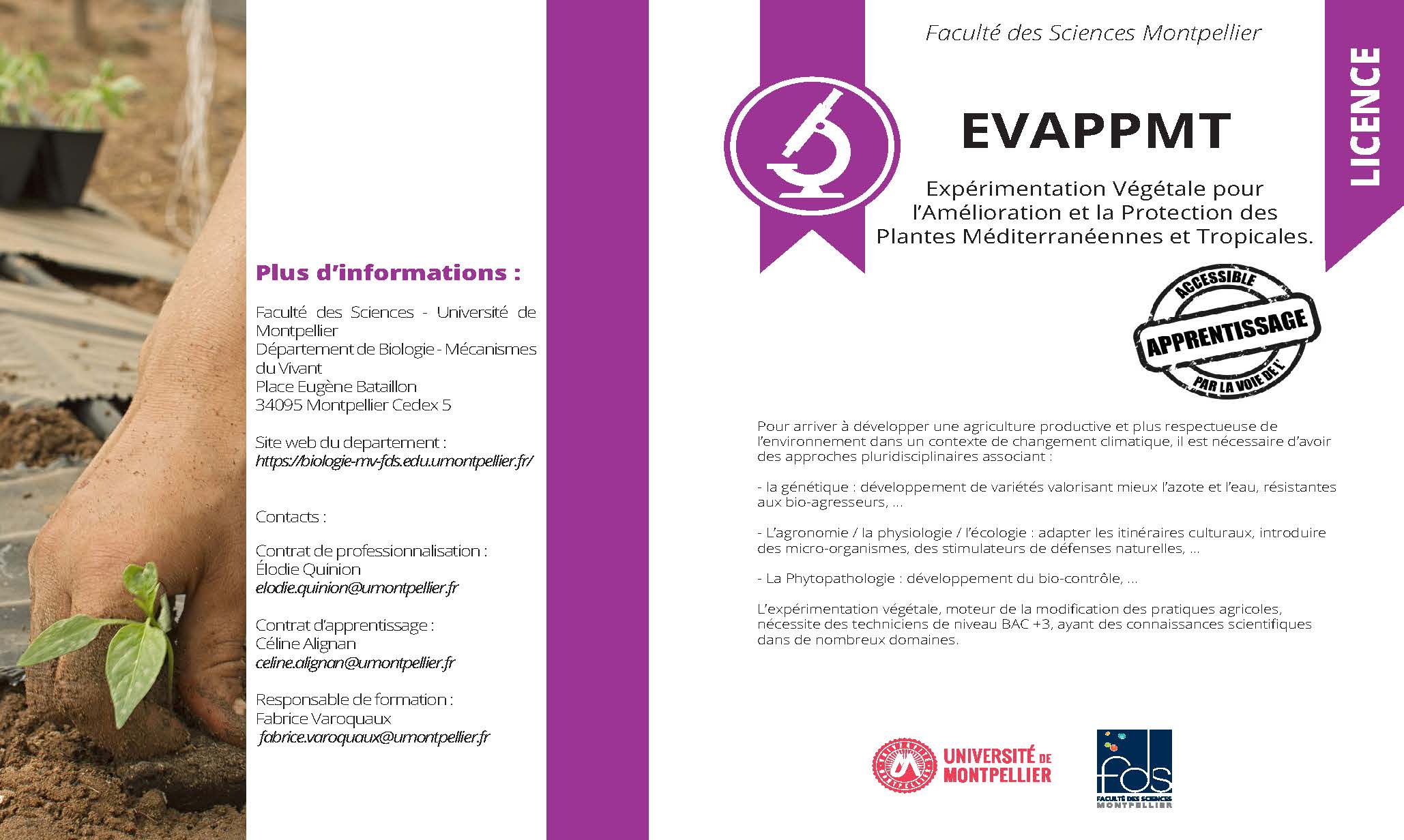
Intensive agriculture does not have only advantages. It relies on the massive use of inputs (fertilizers and pesticides), which is a source of environmental pollution and causes health problems. It therefore seems important to make fundamental changes to agricultural practices in order to limit the use of inputs and transition to a model of sustainable agriculture. This shift in agricultural practices began about twenty years ago but has been accelerated by the ECOPHYTO plan, which aims to reduce the use of pesticides. This agricultural reform must also take place amid the added challenge of climate change. To successfully develop more environmentally friendly agriculturein the context of climate change, multidisciplinary approaches are necessary, combining genetics (development of varieties that make better use of nitrogen and water, are resistant to existing diseases, etc.),agronomy/physiology/ecology (adapting crop rotation systems, introducing microorganisms, Natural Defense Stimulators, etc.), and plant pathology (development of biocontrol, etc.). Plant experimentation, the driving force behind changes in agricultural practices, therefore requires technicians with a three-year post-secondary degree (BAC+3) who possess scientific knowledge across numerous fields.
The goal of this professional bachelor’s degree program, which was launched in 2015, is to train versatile specialists in plant experimentation who can work in a variety of sectors:
– Plant breeding in small and medium-sized enterprises (SMEs), multinational corporations, and research centers such as INRA and CIRAD. The seed industry is extremely important in France, as the country is the leading producer in Europe and the world’s top exporter. This sector accounts for more than 15,000 full-time equivalents and approximately 2.9 billion euros in revenue. It is also worth noting that the research budget stands at 236 million euros and has increased by 25% over the past five years. Seed companies are particularly well established in southern France: nearly all of them operate an experimental station within a 100-kilometer radius of Nîmes.
– Crop protection within companies or laboratories working on the discovery, registration, or testing of new crop protection products. Replacing crop protection products with less harmful natural substances is one of the most difficult challenges facing the agriculture of the future. The growth of companies specializing in biocontrol (the use of macro- or microorganisms, natural defense stimulators, etc.) began in 1985, when 200 small companies shared a combined revenue of $150 million (global figures). It was merely a niche market, accounting for just 1% of pesticide sales. This market has grown, reaching $1 billion in 2009, and forecasts suggest it will reach $8 billion between 2015 and 2020. The development of such substances requires extensive experimentation, some of which will be conducted by rapidly growing companies in the Montpellier region (Staphyt).
– Optimization and adaptation of crop rotation systems at plant experimentation centers and research centers. There are numerous experimentation centers in the region, such as GEVES, CTIFL, CEHM, and ARVALIS.
While the challenges of developing sustainable agriculture are significant for developed countries, they are crucial for many countries in the Global South, which cannot afford fertilizers or pesticides anyway. CIRAD and IRD have established partnerships with research centers in the Global South. Seed companies and agricultural producers (e.g., sugar, etc.) in the Global South require highly qualified technical specialists.
Objectives
The L3Pro EVAPPMT program aims to provide the knowledge, expertise, and skills necessary to work as an experimental technician in various industries. The 5-month internship and the supervised project allow students to apply the theoretical knowledge learned in class. The program also accepts students in work-study programs: continuing education, professional contracts, and apprenticeships. The work-study program is an undeniable asset for entering the workforce in private companies.
Expertise and Skills
Subject-specific skills:
- methods of selective breeding and seed production.
- methods for (i) testing and registering plant protection products; (ii) testing new plant varieties; and (iii) testing new production systems designed to limit the use of inputs and enable crops to adapt to climate change or regulatory requirements (e.g., restrictions on plant protection products).
- the design of experimental plans and statistical analyses.
- plant experimentation in the Global South.
.
Transferable skills:
- Independently conduct, manage, monitor, and evaluate plant experiments in the fields of genetic improvement and crop protection, particularly biological control.
- Conduct scientific and technical literature reviews.
- Optimize experimental protocols.
- Analyze the results and report them to your supervisor, proposing hypotheses or solutions necessary for continuing the work.
- Developing a career plan, writing a resume and cover letters
- Ability to work both independently and as part of a team
- Gain initial experience in entering the workforce
Organization
Knowledge Assessment
Assessments are a combination of ongoing assessments and final exams
Special Features
To take this course, you’ll need a decent laptop. Some of the statistics classes and exams are conducted using R. Completing the supervised projects and various assignments within the modules requires the use of a computer. Depending on health conditions, it’s also possible that some classes will be held remotely, in which case you’ll need not only a computer but also a reliable internet connection.
Open on an alternating basis
Contract Type | Apprenticeship Contract, Professional Training Contract |
|---|
A schedule has been developed to accommodate work-study students (apprenticeships, professional contracts), vocational trainees, and continuing education students.
Internships, supervised projects
Internship | Required |
|---|---|
Duration of the internship | 5 |
Internship Abroad | Possible |
Duration of the internship abroad | 5 |
The 5-month internship runs from April 1 to August 31. It can take place at a company, a technical center, or a public research organization. For more information --> see the "Company Internship" module
The supervised project takes place between early January and mid-March. For more information --> see the "Supervised Project" module
Program
The L3pro EVAPPMT program is spread over two semesters, each consisting of course units (UE) that, upon successful completion, earn ECTS credits. The UE are rarely shared across courses and allow for a high degree of specialization in plant experimentation. TheL3ProEVAPPMT program can be pursued as an initial training program or through a work-study program. This has required the implementation of a schedule tailored to the work-study format.
Select a program
L3 - Professional Bachelor's Degree - Plant Experimentation for the Improvement and Protection of Mediterranean and Tropical Plants (EVAPPMT)
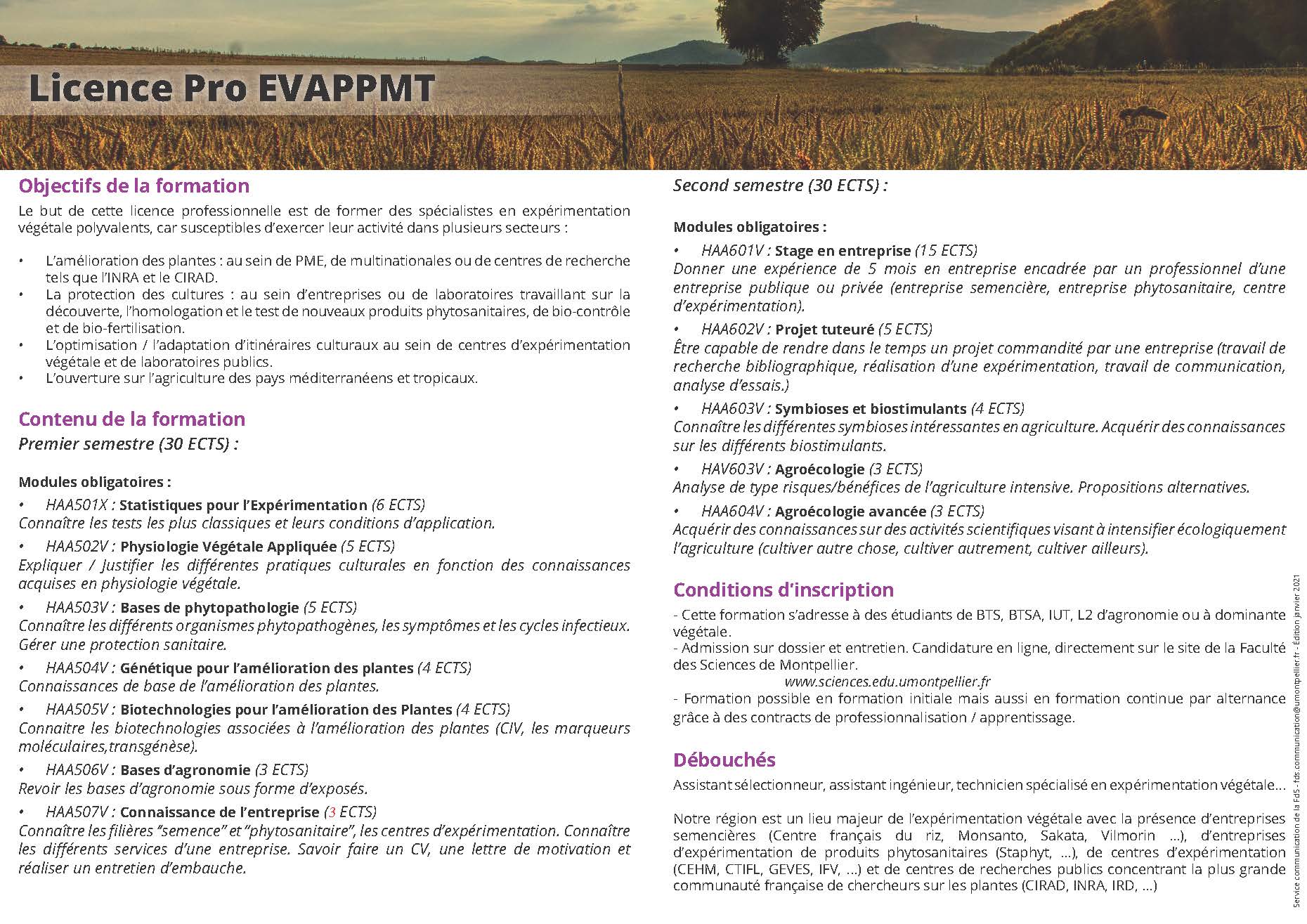
Genetics for Plant Breeding
4 creditsBiotechnology for Plant Breeding
4 creditsFundamentals of Agronomy
3 creditsStatistics for the Experiment
6 creditsBusiness Knowledge
3 creditsApplied Plant Physiology
5 creditsFundamentals of Plant Pathology
5 credits
Fundamentals of Agroecology
3 creditsSupervised Project
5 creditsInternship
15 creditsAdvanced Agroecology
3 creditsSymbiosis and Biostimulants
4 credits
Admission
Admission Requirements
The EVAPPMT Professional Bachelor's Degree program primarily admits students who have successfully completed:
- BTS programs related to crop production (e.g., APV, PH)
- BTS degrees related to biotechnology and laboratory techniques (e.g., ANABIOTEC)
- DUTs in “Biological Engineering.”
A few spots are also reserved for students in other programs (various master’s programs, third-year plant science students, etc.)
Registration Procedures
Applications must be submitted through the University of Montpellier’s FdS e-candidat portal. They are reviewed by an academic committee, which decides on admission. Applicants’ motivation and their vision for a career as a plant experimentation technician are key selection criteria. Securing a work-study contract—while not mandatory—is strongly encouraged.
French and European students: Follow the “eCandidat” procedure on the website: https://ecandidat.umontpellier.fr/ecandidat/
Target Audience
Mandatory Prerequisites
A two-year post-secondary degree in agronomy, crop protection, crop production, biological engineering, or biotechnology.
Have a working computer and an internet connection
Recommended Prerequisites
Have secured a professional or work-study contract, or have identified companies that may offer work-study contracts.
And then
Continuing Education
The L3pro EVAPPMT program is designed to train experimental technicians who will enter the workforce upon graduation. A small number of students may choose to continue their studies in a professional master’s program or at an engineering school, although this is not encouraged.
Employment Placement
Fields of Activity: The goal of this professional bachelor’s degree is to train versatile specialists in plant experimentation who can work in a variety of sectors:
– Plant breeding within small and medium-sized enterprises (SMEs), multinational corporations, or research centers such as INRAE and CIRAD
– Crop protection within companies or laboratories working on the discovery, registration, or testing of new plant protection products and biocontrol agents.
– Optimization and adaptation of crop rotation systems at plant research centers and public or private laboratories
Available Job Types: The positions in question are assistant breeder, assistant engineer, and technician specializing in plant experimentation.
Examples.
1- Working at a seed company
- "Market Release" Research Technician (post-market variety testing, support for seed producers [protocol optimization])
- "Production" Laboratory Technician (seed quality testing)
- Research Technician (Assistant Selector)
For more information on these careers:
http://www.gnis-pedagogie.org/fiches-metiers-semences-vegetales.html
2- Work at an experimental company
- Seed Testing Technician.
- Plant Protection and Nutrition Research Technician.
- Environmental and Beneficial Wildlife Researcher.
For more information on these careers: