

Level of Education
4-year college degree
ECTS
8 credits
Training Structure
College of Sciences
Time of year
Fall
Description
The professional project bridges the gap between traditional practical work and laboratory or industry internships. It takes the form of a supervised project in which students are placed in a professional setting through collaborative (group) work based on the completion of a project addressing a problem identified by a company, local government, nonprofit organization, or academic institution. It is part of the core curriculum of the Master’s in Chemistry and is carried out under the supervision of a faculty member or industry professional serving as a mentor. Conducted throughout the semester, this project aims to integrate and reinforce the knowledge and skills acquired during the undergraduate and early Master’s programs through this professional scenario. These real-world scenarios will be directly related to the Master’s track chosen by the students. In addition to disciplinary skills in chemistry, students will also acquire interpersonal, organizational, and communication skills—which are intrinsically linked to project management—thereby equipping them for their future professional careers.
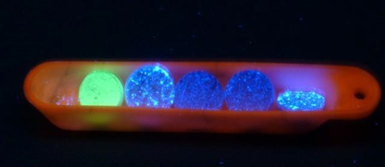
Addressing a research problem: an example of the synthesis of new phosphorescent materials.
Hourly volumes*:
CM: 5 hours
TD: 5 hours
Practical Training: 40 hours
Objectives
The objectives of the supervised projects are for the student to:
- Knowing how to address an industrial or academic problem
- Be able to place this issue within a broader context and in relation to the current state of the art,
- Be able to develop a set of specifications related to the issue at hand and propose innovative solutions,
- Develop a design of experiments in collaboration with the other members of the group
- Manage your own safety and that of others; act as a responsible chemist
- Implement security measures appropriate for a synthesis
- Master analytical and characterization techniques in various fields to successfully complete the project assigned to him or her,
- Be able to analyze and interpret data based on knowledge acquired during their studies or on data from the literature,
- Conduct a critical analysis of the results obtained in relation to the initial objectives and the state of the art, and be able to adapt one’s approach based on successes and failures.
- Present the project's findings through a scientific publication in English and an oral presentation to a panel of judges.
Class Hours
- Professional Projects – Project Monitoring – Practical WorkPractical Work40 hours
- Professional Projects – Project Monitoring – TutorialsTutorials5 hours
- Professional Projects – Project Management - CMLecture5 hours
Mandatory Prerequisites
Bachelor's degree in Chemistry (Organic Chemistry, Materials Chemistry, Biochemistry), Biochemistry, or Physical Chemistry
Basic knowledge of chemical synthesis and analysis.
Knowledge Assessment
Continuous Assessment + Final Oral Exam
Course Outline
Introduction to Scientific Ethics
Bibliographic Research
Risks and Safety in Chemistry
Preparing for a Defense / Writing a Report in English
A 40-hour experimental project on an industrial or academic problem: Synthetic and analytical approaches related to the student’s chosen track
Use of synthesis and analytical equipment (synthesis microwave, hydrothermal systems, FT-IR, Raman, and NMR spectroscopy, mass spectrometry, scanning electron microscopy, chromatography systems, etc.)
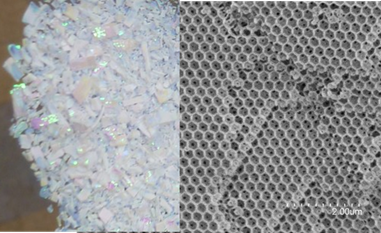
Combining different skills to carry out a project: an example of inverted opals synthesized by combining macromolecular and soft chemistry via a sol-gel process (left) and observed under a scanning electron microscope (right).
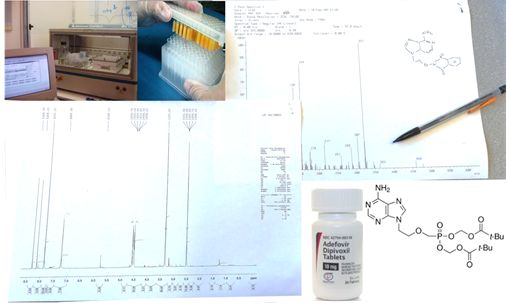
Example: Synthesis and Characterization by NMR and Mass Spectrometry of an Intermediate for the Preparation of a Commercial Acyclic Antiviral Nucleotide (Adefovir)
Additional Information
Administrative contact(s):
Master's in Chemistry Office
https://master-chimie.edu.umontpellier.fr/