


Training Structure
College of Sciences
Program
Electron Microscopy, Crystallography
6 creditsSurface Properties M2
3 creditsThermodynamics and Defects in Solids (M2)
5 creditsSummer School: Large-Scale Facilities
7 credits72hProject Preparation for Master's Thesis
3 creditsThin Films and Extreme Conditions M2
3 creditsMaterials for Catalysis M2
3 credits
Master's Thesis
30 credits
Electron Microscopy, Crystallography
Level of Education
5 years of post-secondary education
ECTS
6 credits
Training Structure
College of Sciences
The structural characterization of materials is a mandatory prerequisite for developing functional materials and an absolute necessity for materials science researchers and engineers. To interpret diffraction patterns, structures, microstructures, and so on, a detailed understanding of crystallography, structural analysis, and the instruments used is essential. This knowledge is built from the ground up, gradually leading to an understanding of how to characterize materials using both standard and sophisticated diffraction methods. The course also includes laboratory work on powder and single-crystal diffractometers, enabling students to acquire the skills needed to correctly use and interpret diffraction data. Thefirst-semester portion of the course focuses primarily on X-ray diffraction and electron microscopy, while the crystallography component continues in thesecond semester with topics such as symmetry, structure determination, and structure refinement, as well as neutron scattering and magnetic structure analysis.
This lecture consists of two parts:
(1): Crystallography:
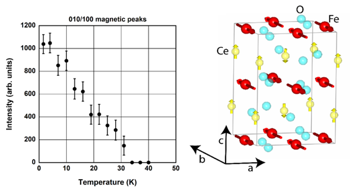
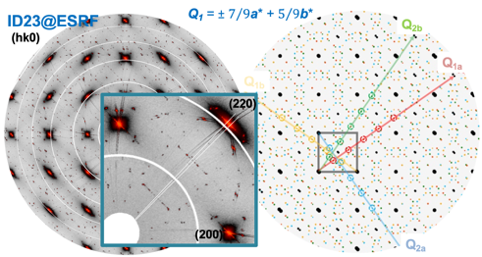
This section is primarily devoted to familiarizing students with structural analysis and its applications. Following a brief introduction to the concept of the reciprocal lattice and the use of space groups in crystallography, the lecture focuses on structural analysis using diffraction methods, including powder and single-crystal X-ray and neutron scattering. This involves gaining an understanding of related techniques—such as the use of powder and single-crystal diffractometers—as well as the techniques and software currently used for structure refinement. The aim of the course is to provide a basic understanding of the principles behind the software, rather than simply using the programs blindly. Students will also collect single-crystal diffraction data using a high-performance 4-cycle diffractometer equipped with a 2D area detector, as well as perform magnetic structure analysis using neutron diffraction methods.
Simple inorganic structures: Space groups, X-ray, neutron, and synchrotron sources, interaction of X-rays, electrons, and neutrons with matter, reciprocal lattice, concept of the Ewald sphere, powder diffractometers, single-crystal diffractometers, orienting matrix, Patterson method, structure refinement from powder or single-crystal data, magnetic structure analysis, magnetic space groups,
(2): Electron microscopy:
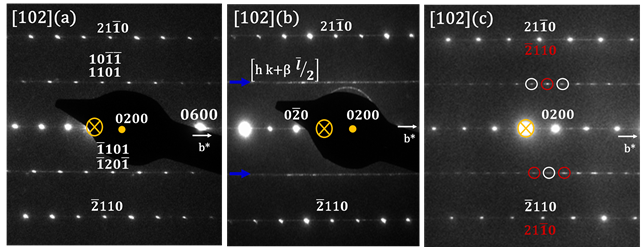
In this section, we will focus on electron microscopy through flipped classroom sessions. We will discuss the following topics: electron sources, lenses and aberrations, sample preparation, electron diffraction, structural and chemical analysis, and imaging techniques.
Hourly volumes*:
CM: 33 hours
Time: 6:00 p.m.
Surface Properties M2
Level of Education
5 years of post-secondary education
ECTS
3 credits
Training Structure
College of Sciences
This course provides comprehensive knowledge and tools related to the surface properties and interfacial behavior of crystalline and amorphous solids in various media. It consists of two parts: (1) Fundamentals of Colloid and Surface Science, and (2) Divided and Porous Solids
(2) Surface characterization techniques and surface analysis
Hourly volumes*:
CM: 5:00 p.m .
TD: 8 a.m.
Thermodynamics and Defects in Solids (M2)
ECTS
5 credits
Training Structure
College of Sciences
Summer School: Large-Scale Facilities
Level of Education
5 years of post-secondary education
ECTS
7 credits
Training Structure
College of Sciences
Number of hours
72h
The objective is to provide second-year master’s students with a solid introduction to the use of “large-scale facilities” for the study and characterization of materials. In particular, we focus on the use of neutron scattering and third-generation synchrotron sources for the study of materials. Indeed, to date, the development and optimization of materials often require sophisticated methods, some of which are accessible only at large-scale facilities. This presents a major challenge for both basic and applied research. The courses, which take place over two consecutive weeks, provide basic instruction on the production of neutrons and synchrotron radiation, as well as their specific applications and how they complement each other. The course content is as follows:
- Neutron and synchrotron sources
- Interaction of neutrons and synchrotron radiation with matter
- Diffraction methods and instrumentation for neutron and X-ray (synchrotron) scattering
- Spectroscopy: inelastic neutron scattering and X-ray absorption spectroscopy
- Magnetic neutron scattering
- Presentation of neutron and synchrotron beamlines
Project Preparation for Master's Thesis
Level of Education
4-year college degree
ECTS
3 credits
Training Structure
College of Sciences
The purpose of this module is to prepare for the master's thesis project, which will last six months during S4.
This thesis project involves the use of large-scale facilities (preparation and securing of beam time for neutron or synchrotron radiation). You will need to review the current state of the art in this area and establish optimal experimental conditions (optimization of experiments on light lines or with neutrons).
This module will help develop "cross-disciplinary" skills, such as the development and organization of a scientific project (collaboration between universities and various EU research centers)
as well as communication skills.
Thin Films and Extreme Conditions M2
ECTS
3 credits
Training Structure
College of Sciences
Materials for Catalysis M2
Level of Education
5 years of post-secondary education
ECTS
3 credits
Training Structure
College of Sciences
Thermodynamic and kinetic principles for understanding the optimal conditions for catalytic reactions and the requirements for catalyst activity and accessibility.
Methods for the preparation of porous and dispersed catalysts using nucleation-growth, aggregation, and templating mechanisms.
Correlations between the structural properties and activity of heterogeneous catalysts.
Examples of the application of heterogeneous catalysts in refining and industrial chemistry processes.
Next, basic concepts of photocatalysis and electrocatalysis are explored
Hourly volumes*:
CM: 5:00 p.m .
TD: 8 a.m.
Master's Thesis
Level of Education
5 years of post-secondary education
ECTS
30 credits
Training Structure
College of Sciences
Thefourth semester of the Master’s program is entirely devoted to the master’s thesis project in Materials Science, which lasts at least five months. Students are assigned a research topic and work within a research team to address a scientific problem. This allows them to apply the skills they have acquired and learn new scientific skills in order to identify the problem and develop a potential solution. The topic is analyzed and described in the written master’s thesis and presented orally before a jury. This should enable the candidate to demonstrate his ability to address a scientific problem and present it in an analytical manner.