

Level of Education
4-year college degree
ECTS
5 credits
Training Structure
College of Sciences
Description
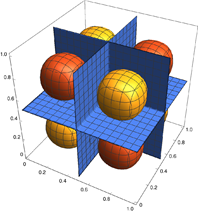
Wave function of an excited electron trapped in a cubic box: a model for a quantum dot state
- Introduction to basic concepts in quantum physics and their relationship to chemistry, modern materials science, and the engineering of nanodevices.
- To achieve the goals of this course, a mathematically rigorous approach is combined with a physical interpretation of the concepts, and the application of the most important quantum mechanical models to electronic and magnetic spectroscopies and chemistry is illustrated.
Hourly volumes*:
CM (Readings):24 hours
TD (Tutorials): 12 hours
Objectives
By the end of the course, students should be able to:
- A real understanding of the quantum nature of matter; an introduction to simple models in quantum mechanics.
- a true understanding of the theoretical formalism used to describe quantum phenomena, which is necessary for the characterization and engineering of materials.
- in-depth knowledge of electronic states; quantum numbers, electronic transitions, and their relationship to spectroscopy; electronic states in electric and magnetic fields.
- the necessary background for further study of computational modeling methods and advanced techniques applicable to the elucidation of electronic and geometric structures, as well as the spectroscopic properties of materials.
Class Hours
- Quantum Mechanics and Modeling I - LectureLecture30 hours
- Quantum Mechanics and Modeling I - TutorialTutorials3:00 p.m.
Mandatory Prerequisites
Differential calculus. Matrix algebra. A knowledge of crystallography,
Knowledge Assessment
CCI
Course Outline
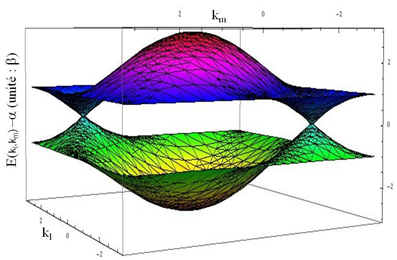
Electronic Band Structure of a Graphene Sheet for Nanomaterials
Quantum Mechanics and Modeling
1 Quantum Mechanics: Mathematical Background
1.1 Postulates of Quantum Mechanics
1.2 Operators
1.3 Eigenfunctions and Eigenvalues
2 The Schrödinger Equation
2.1 Historical Background
2.2 The Uncertainty Principle
2.3 The Time-Dependent Schrödinger Equation
2.4 The Time-Independent Schrödinger Equation
3 Classical 1-particle quantum models
3.1 Translational motion: application to electron microscopy
3.2 Particle in a 1D box
-quantum confinement and zero-point energy
3.3 Particle in a rectangular well:
-Application to the physics of quantum dots and F-centers
3.4 Potential Barriers and Tunneling
-application to scanning tunneling microscopy (STM)
3.5 The Harmonic Oscillator
-application to molecular vibration
3.6 Particle on a Ring
-Introduction to Angular Momentum
3.7 Particle on a Sphere
-application to molecular rotation
4 Angular Momentum
4.1 The Angular Momentum Operators
4.2 Eigenvalues and Eigenfunctions of Angular Momentum
4.3 Spin
4.4 The Angular Momenta of Composite Systems
4.5 Coupling of Several Angular Momenta
4.6 The Conservation of Angular Momentum
5 Techniques of Approximation
5.1 Time-Independent Perturbation Theory
5.2 Variation Theory
6 Atomic Structure
6.1 The Spectrum of Atomic Hydrogen
6.2 Spin: Fine Structure and Spin-Orbit Coupling
6.3 Pauli Principle
6.4 Structure and Spectrum of the Helium Atom
6.5 Approximate Atomic Orbitals: Self-Consistent Fields and HF Equations
6.6 Correlated Electronic Motion
6.7 Selection Rules

Response properties of a CO molecule poisoning the surface of a fuel cell catalyst
Bibliography
References:
- R. C. Greenhow, *Introductory Quantum Mechanics*, Hilger, Brisot, New York, ESM, Cambridge, 1990 .
- David Griffiths, *Introduction to Quantum Mechanics*, Pearson New International Edition, London (first and second editions)