

ECTS
180 credits
Duration
3 years
Training structure
Faculty of Economics
Presentation
The University of Montpellier and Lycée Joffre offer a CPES (Preparatory Cycle for Higher Education)in Modeling and Digital Technology in Economics. This selective three-year program, co-organized by the high school and the university, leads to a bachelor's degree and offers a sought-after dual skill set, with an introduction to research in the first year.
Students benefit from enhanced supervision by preparatory class teachers and university lecturers and researchers. The first year combines a core curriculum in computer science, mathematics, humanities, and general culture with specific courses depending on the chosen path. Specialization occurs gradually, accompanied by projects and introductory research internships.
The original operation The CPES alternates between high school and university: in the first year, four days at high school and one day at university to deepen learning and carry out projects. In the second year, time is split between the two institutions, and in the third year, the bachelor's degree is completed entirely at the university with additional teaching for enhance digital and computer skills. 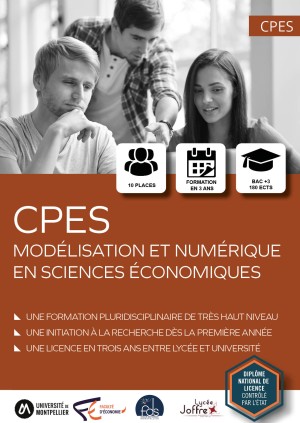
The advantages of the training program
- HIGH-LEVEL TRAINING
- INTRODUCTION TO RESEARCH
- ENHANCED SUPERVISION
Objectives
-
Acquire dual skills in economics and digital and IT tools to prepare for demanding higher education and careers that require this complementary knowledge.
-
Introduce students to research from their first year onwards, in order to develop their analytical skills, scientific curiosity, and academic working methods.
-
To offer high-level multidisciplinary training, combining mathematics, computer science, humanities, and economics, in order to train versatile students who are capable of adapting to a variety of contexts.
-
Promoting independence and personal development through personalized support, small-scale promotion, and practical projects.
-
Prepare to continue your studies with a bachelor's degree and then a master's degree, with a solid foundation and progressive specialization in the digital and economic fields.
Know-how and skills
Know-how
-
Analyze and model economic data using digital and computer tools.
-
Solve complex problems by combining mathematics, statistics, and economic concepts.
-
Design and implement projects incorporating multidisciplinary methods and a scientific approach.
-
Research, synthesize, and communicate relevant information in an academic context.
-
Use advanced digital and computer tools tailored to economics and research projects.
Skills
-
Scientific rigor and analytical thinking, to tackle complex situations and produce reliable results.
-
Autonomy and work organization, with the ability to plan and manage projects across multiple disciplines.
-
Ability to work in a team on practical projects and share results clearly.
-
Adaptability and versatility, thanks to multidisciplinary training and alternating between high school and university.
-
Preparation for higher education, particularly bachelor's and master's degrees, with dual expertise in economics and digital technology
International dimension
In the second semester of the third year, students can study at one of the 60 universities with which the Faculty of Economics has partnerships through the ERASMUS+ exchange programs, inter-university agreements, and CHARM-EU.
Limited number of places
https://economie.edu.umontpellier.fr/international/
Organization
Knowledge assessment
The Bachelor's Degree in Economics, structured over three years and six semesters, is based on an assessment system designed to measure students' learning progressively and comprehensively. At the end of each semester, the skills, competencies, and knowledge acquired in each Teaching Unit (UE) are assessed in one of two ways: continuous assessment or a final exam.
Continuous assessment allows for regular monitoring of student progress through several forms of evaluation: supervised assignments, graded tutorials, presentations, projects, document analysis, and active participation in class. This method encourages attendance, regular work, and the gradual acquisition of skills.
The final exam consists of a written or oral test held at the end of the semester. It aims to assess the student's overall mastery of the concepts taught and their ability to apply their knowledge in a structured and in-depth manner.
Depending on the course units, teaching methods, or learning objectives, some units may combine both assessment methods. These methods ensure fair and diverse assessment that is tailored to the nature of the course, while allowing students to develop methodology, rigor, and autonomy throughout their academic career.
Special facilities
Students with disabilities, young entrepreneurs, and high-level athletes can benefit from personalized support.
This may take the form of study arrangements, educational adaptations, or specific rights, in order to enable them to best balance their personal or professional constraints with their university education. Depending on the situation, these measures may include an adapted schedule, adjusted assessment methods, attendance facilities, individualized monitoring, or dedicated support services.
Internships, supervised projects
Internship | Possible |
|---|---|
Duration of the internship | Maximum 924 hours, or 6 months |
Internship abroad | Possible |
A true immersion in the professional world, it allows students to apply the knowledge they have acquired in class, discover how organizations work, and compare theory with practice. To get the most out of it, serious preparation is essential: learning about the host organization, defining your objectives, mobilizing your skills, and preparing for professional demands.
During a bachelor's degree, internships are possible and optional. They must be related to the course of study.
The internship may begin at the end of the second semester exams or be completed during university vacation periods. In all cases, it must end no later than August 31, regardless of whether the student is enrolled in a Bachelor's degree, Master's degree, or University Diploma program.
Please note: students may only begin their internship immediately after the second semester exams if they have successfully completed their year in the first session.
Program
The program lasts three years, or six semesters.
180 ECTS
Advanced CPES Mathematics S2
2 creditsContemporary World Issues S2 (Joffre)
1 creditMath S2 (Joffre)
5 creditsComputer Science S2 (Joffre)
4 creditsAdvanced CPES Macroeconomics S2
4 creditsEconomics S2 (Joffre)
7 creditsCPES Economics Project, 10th grade
1 creditAdvanced CPES Computer Science S2
2 creditsGeneral Culture S2 (Joffre)
2 creditsModern Language S2 (Joffre)
2 creditsOptional
Math S3 (Joffre)
2 creditsAdvanced CPES Mathematics S3
2 creditsEnglish CPES S3
1 creditAdvanced CPES Computer Science S3
2 creditsGeneral Mathematics Supplements CPES S3
2 creditsAdvanced Study 1 Economics CPES S3 (Statistics + Econometrics)
6 creditsComputer Science S3 (Joffre)
2 creditsEconomics S3 (Joffre)
6 creditsGeneral Culture S3 (Joffre)
1 creditAdvanced Economics CPES S3 (Eco+Digital)
6 creditsOptional
General Culture S4 (Joffre)
1 creditAdvanced CPES Computer Science S4
2 creditsMath S4 (Joffre)
2 creditsApplied Microeconomics
5 creditsAdvanced Study 1 Economics CPES S4 (Statistics + Econometrics)
6 creditsAdvanced CPES Mathematics S4
2 creditsCPES Economics Project S4
3 creditsComputer Science S4 (Joffre)
2 creditsEnglish CPES S4
1 creditEconomics S4 (Joffre)
6 creditsOptional
Introduction to Econometrics
4 creditsGame theory
4 creditsEnglish S5
2 creditsOptimization
3 creditsIndustrial organization
Economy and Digital Technology
5 creditsOptional
Economy and digital technology
4 creditsOperational research
3 creditsData analysis
3 creditsDatabase
4 creditsEnglish S6
2 creditsProject L3 CPES S6
5 creditsOptional
Admission
Admission requirements
- For Bachelor's Degree 1: High school diploma or equivalent
- For the second year of a bachelor's degree: first year of a bachelor's degree or equivalent (after review by a committee)
- For Bachelor's Degree 3: Bachelor's Degree 2 or equivalent (after review by the committee)
https://economie.edu.umontpellier.fr/candidatures/
Registration procedures
First year of CPES Bachelor's degree
If you are in your final year of high school or wish to change direction for the start of the academic year in the first year of a bachelor's degree, you must apply via Parcoursup between January and March. Admission offers and responses to applicants will be sent out on a rolling basis between June and July.
Target audience
High school and college students from the Montpellier Academy, the Occitanie region, France, and internationally
Tuition fees
Tuition fees are set each year by the Ministry of Higher Education. They are accompanied by the Student and Campus Life Contribution (CVEC).
The entire program is free for students receiving scholarships.
Capacity
Recommended prerequisites
-
Strong interest in economics, digital tools, and computer science.
-
Ability to work independently and motivation, as the training is demanding and multidisciplinary.
-
Open-mindedness and intellectual curiosity, to follow courses in humanities, social sciences, and economics.
-
Analytical mind and ability to think logically, necessary for modeling and research projects.
And after
Continuing education
Approximately 90% of students continue their studies after completing their bachelor's degree (mainly in a master's program). Most master's programs in economics and finance in France are selective and require a bachelor's degree in economics.
Other students take civil service exams or enroll in business schools through parallel admission.
A very small number of students stop studying after obtaining their bachelor's degree.