


Target level of study
Master's degree
ECTS
120 credits
Duration
2 years
Training structure
Faculty of Economics
Language(s) of instruction
French
Presentation
The Master's degree in Money, Banking, Finance, and Insurance (MBFA) atthe Faculty of Economics in Montpellier trains specialists capable of analyzing, evaluating, and modeling various financial risks. This program develops advanced skills in financial product evaluation, risk management, banking regulation, and understanding the functioning of financial institutions and financial markets.
The Master's program also prepares students to conduct economic and financial studies for public agencies, banking institutions, insurance companies, and companies in the financial sector.

The advantages of the training program
-
HIGHLY PROFESSIONAL TRAINING
-
MASTERY OF TOOLS AND METHODS
- COURSES OPEN TO APPRENTICESHIPS
Objectives
The MBFA Master's program aims to train highly qualified experts in the fields of banking, finance, insurance, financial markets, and financial engineering, capable of:
-
Analyze, evaluate, and model the financial risks faced by institutions (banks, insurance companies, etc.);
-
Acquire in-depth financial knowledge and advanced technical skills (econometrics, quantitative finance, risk management, programming, financial databases);
-
Be quickly operational in finance, risk control, consulting, or financial product management roles.
Know-how and skills
Know-how
-
Analyze, assess, and model financial risks (market, credit, liquidity, actuarial).
-
Evaluate complex financial products and build structured portfolios.
-
Implement modeling, econometrics, and financial engineering methods.
-
Use specialized financial market computer tools and software.
-
Conduct analysis and research in finance and economics.
Skills
-
Proficiency in financial and actuarial risk management.
-
Expertise in banking, finance, and regulation.
-
Ability to analyze and assist in financial decision-making.
-
Autonomy in processing complex financial data.
International dimension
From the second year onwards, students can study at one of the 60 universities with which the Faculty of Economics has partnerships as part of the ERASMUS+ exchange programs, inter-university agreements, and CHARM-EU.
Organization
Knowledge assessment
The Master's programs at the Faculty of Economics are structured over two years and four semesters, based on an assessment system designed to measure students' learning progressively and comprehensively. At the end of each semester, the skills, competencies, and knowledge acquired in each teaching unit (UE) are assessed in one of two ways: continuous assessment or a final exam.
Continuous assessment allows for regular monitoring of student progress through several forms of evaluation: supervised assignments, graded tutorials, presentations, projects, document analysis, and active participation in class. This method encourages attendance, regular work, and the gradual acquisition of skills.
The final exam consists of a written or oral test held at the end of the semester. It aims to assess the student's overall mastery of the concepts taught and their ability to apply their knowledge in a structured and in-depth manner.
Special facilities
Students with disabilities, young entrepreneurs, and high-level athletes can benefit from personalized support.
This may take the form of study arrangements, educational adaptations, or specific rights, in order to enable them to best balance their personal or professional constraints with their university education. Depending on the situation, these measures may include an adapted schedule, adjusted assessment methods, attendance facilities, individualized monitoring, or dedicated support services.
Open alternately
Apprenticeships are based on the principle of alternating between academic and practical training at university and acquiring skills with an employer. The pace of this alternation varies depending on the program, but follows a schedule established in advance.
The apprenticeship contract is a special employment contract that allows students to benefit from dual status: student and full-time employee of the company.
MANDATORY INTERNSHIPS IN M1 AND M2
- Professional and Corporate Account Manager
APPRENTICESHIP POSSIBLE IN M2
- Financial Engineering
- Economic and Financial Information System
economie.edu.umontpellier.fr/career/apprenticeship-training/
Internships, supervised projects
Internship | Possible |
|---|---|
Duration of the internship | Maximum 924 hours, or 6 months |
Internship abroad | Possible |
A true immersion in the professional world, it allows students to apply the knowledge they have acquired in class, discover how organizations work, and compare theory with practice. To get the most out of it, serious preparation is essential: learning about the host organization, defining your objectives, mobilizing your skills, and preparing for professional demands.
All Master's programs offer the possibility of doing an internship.
In Master 1, internships are possible and optional. They must be related to the program.
The internship may begin at the end of the second semester exams or be completed during university vacation periods. In all cases, it must end no later than August 31, regardless of whether the student is enrolled in a Bachelor's degree, Master's degree, or University Diploma program.
In Master 2, the internship is mandatory.
The start date is set in agreement with the academic supervisor, generally between February and March, in order to fit in with the training schedule and the requirements of the final thesis. Regardless of the period chosen, the internship mustend no later than September 30.
economie.edu.umontpellier.fr/career/go-on-an-internship/
Program
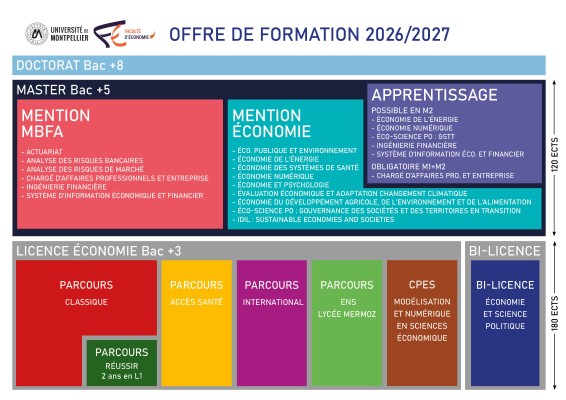
Select a program
Actuarial science
The Actuarial Science program is one of the programs offered by the Faculty of Economics under the Money, Banking, Finance, and Insurance (MBFA) major.
It aims to provide students with a solid foundation of theoretical and methodological knowledge enabling them to pursue a career as an actuary, while also preparing future researchers in the fields of actuarial science, finance, and insurance.
What is an actuary?
An actuary is a professional who specializes in applying probability calculations and statistics to issues related to insurance, finance, and social welfare.
Their role consists of analyzing and quantifying risks, assessing their financial impact, and estimating the future cash flows associated with them. To do this, actuaries use advanced mathematical tools, mainly from probability theory and statistics, to model and predict future events such as:
-
the length of human life,
-
the frequency of claims,
-
or the extent of the associated financial losses.

Theoretical econometrics
5 creditsMarket finance
4 creditsMonetary and financial macroeconomics
3 creditsForecasting methods
5 creditsAlgorithms and Programming
3 creditsData mining and big data
Data warehouse
Language selection list
Choose one of two options:
English for Finance 1
2 creditsSpanish 1
Economics of Bancassurance
3 credits
Introduction to Stochastic Calculus
4 creditsCorporate finance
4 creditsIntroduction to SAS / Excel VBA
2 creditsActuarial models in Excel VBA
3 creditsTime series econometrics
5 creditsTechnical analysis
2 creditsApplied econometrics project
5 creditsActuarial techniques
3 creditsChoose one of two options:
English for Finance 2
2 creditsSpanish 2
2 credits
Optional
Financial markets and financial theory
2 creditsProfessional development conferences
Trading algorithm
1 creditPortfolio management under R
1 creditNon-Life Actuarial Science
3 creditsFinancial analysis (Bank of France)
1 creditIntroduction to Artificial Intelligence in Python
0.5 creditsPrimary stock market: initial public offering
0.5 creditsStochastic calculus
2 creditsFinancial English
1 creditEnterprise risk management
1 creditExploratory statistics (SAS)
1 creditComputer techniques (VBA)
1 creditModeling emerging risks
2.5 creditsLife Actuarial Science
2.5 creditsCybersecurity and cryptography
1 creditEconometrics applied to finance
2 creditsFinancial market econometrics
2 creditsFinancial big data
1 creditFinTechs, Blockchain, and Cryptocurrencies
1 creditNumerical methods in actuarial science "VBA"
2 creditsBanking and insurance regulations
1 credit
OPTION 1
30 creditsChoose 1 or 2 from 2
Research thesis as part of a research program
30 credits3- to 6-month internship
30 credits
Introductory seminars on research
Banking Risk Analysis
The Banking Risk Analysis track of the MBFA Master's program trains professionals and researchers specializing in banking and financial risk analysis and data science. It combines modern programming, statistical methods, and analysis of large financial databases to address the new challenges facing the sector.
The program takes into account developments in the banking and finance sector, the complexity of international operations, and new prudential regulatory requirements such as Basel III, particularly with regard to liquidity risk and asset-liability management (ALM), as well as proficiency in artificial intelligence tools. Quantitative courses are held in the Trading Room.
The program is highly professionalizing thanks to partnerships with banking institutions, guest lectures by professionals, conferences on Big Data and AI, and applied projects, promoting access to internships andemployment. The majority of graduates find employment within six months, with an employment rate of over 80%.
Choose one of two options:
English for Finance 1
2 creditsSpanish 1
Theoretical econometrics
5 creditsMarket finance
4 creditsMonetary and financial macroeconomics
3 creditsForecasting methods
5 creditsAlgorithms and Programming
3 creditsData mining and big data
Data warehouse
Economics of Bancassurance
3 credits
Optional
Choose one of two options:
English for Finance 2
2 creditsSpanish 2
2 credits
Introduction to Stochastic Calculus
4 creditsCorporate finance
4 creditsIntroduction to SAS / Excel VBA
2 creditsBanking techniques
3 creditsTime series econometrics
5 creditsTechnical analysis
2 creditsApplied econometrics project
5 creditsFinancial Mathematics in Excel VBA
3 credits
Professional development conferences
Financial markets and financial theory
2 creditsNumerical methods in banking "VBA"
2 creditsTrading algorithm
1 creditPortfolio management under R
1 creditFinancial analysis (Bank of France)
1 creditPrimary stock market: initial public offering
0.5 creditsStochastic calculus
2 creditsOperational and compliance risks
2 creditsFinancial English
1 creditIntroduction to Artificial Intelligence in Python
0.5 creditsExploratory statistics (SAS)
1 creditComputer techniques (VBA)
1 creditFinancial big data
1 creditCredit risk
2 creditsCybersecurity and cryptography
1 creditEconometrics applied to finance
2 creditsFinancial market econometrics
2 creditsAsset-liability management (ALM)
2 creditsInterest rate risks
2 creditsFinTechs, Blockchain, and Cryptocurrencies
1 creditNumerical methods in actuarial science "VBA"
2 creditsProgramming in R
Banking and insurance regulations
1 credit
Introductory seminars on research
OPTION 1
30 creditsChoose 1 or 2 from 2
Research thesis as part of a research program
30 credits3- to 6-month internship
30 credits
Market Risk Analysis
The Market Risk Analysis program aims to train both professionals and researchers specializing in finance, with a particular focus on products traded on financial markets such as stocks, bonds, derivatives, currencies, and commodities. The program combines solid theoretical instruction with an in-depth quantitative approach, enabling students to understand how markets work and how financial instruments are valued.
Students acquire skills in financial risk management and measurement through the use of advanced statistical methods, such as volatility analysis, Value at Risk (VaR), Expected Shortfall (ES), and backtesting of risk models. They also learn how to assess portfolio exposure, identify major risk factors, and implement effective hedging strategies.
Choose one of two options:
English for Finance 1
2 creditsSpanish 1
Theoretical econometrics
5 creditsMarket finance
4 creditsMonetary and financial macroeconomics
3 creditsForecasting methods
5 creditsAlgorithms and Programming
3 creditsData mining and big data
Data warehouse
Economics of Bancassurance
3 credits
Introduction to Stochastic Calculus
4 creditsAsset valuation
3 creditsCorporate finance
4 creditsIntroduction to SAS / Excel VBA
2 creditsPortfolio allocation
3 creditsTime series econometrics
5 creditsTechnical analysis
2 creditsApplied econometrics project
5 creditsOptional
Choose one of two options:
English for Finance 2
2 creditsSpanish 2
2 credits
Numerical methods
3 creditsFinancial markets and financial theory
2 creditsProgramming in VBA
1 creditStochastic calculus
2 creditsPortfolio management
4 creditsFinancial English
1 creditTrading algorithms
2 creditsData mining and big data
3 creditsExploratory statistics (SAS)
1 creditComputer techniques (VBA)
1 creditMarket risks
4 creditsFinancial econometrics
5 creditsProgramming in R, Python
1 credit
OPTION 1
30 creditsChoose 1 or 2 from 2
Research thesis as part of a research program
30 credits3- to 6-month internship
30 credits
Professional speakers
Introductory seminars on research
Professional and Corporate Account Manager
OPENING SEPTEMBER 2026
The Master's degree in Professional and Corporate Account Management (CAPE) trains professional and corporate account managers to fulfill their duties of managing, advising, and developing the portfolios of a client base comprising artisans, merchants, independent professionals, microbusinesses, and SMEs, while taking into account developments in the banking and financial sector and regulatory constraints.
This program provides a solid foundation in economic, banking, and financial analysis, as well as mastery of quantitative and digital analysis tools, promoting a focus on Professional and Corporate Business Centers.
The training program enables participants to acquire essential technical, commercial, and behavioral skills, while developing a solid understanding of risks, which is essential for success in this sector.

Financial Engineering
The Financial Engineering track of the MBFA Master's program aims to train bothprofessionals and specialized researchers. It prepares students to become experts inadvanced financial engineering techniques, capable of analyzing and solving complex problems in a strategic and global context.
The program emphasizes the international dimension of financial markets and institutions, enabling graduates to understand global economic and financial issues. Students develop both technical and analytical skills, enabling them to develop innovative solutions, structure complex financial products, and respond to the strategic challenges faced by banks, asset management companies, insurance companies, and international financial institutions.
Choose one of two options:
English for Finance 1
2 creditsSpanish 1
Theoretical econometrics
5 creditsMarket finance
4 creditsMonetary and financial macroeconomics
3 creditsForecasting methods
5 creditsAlgorithms and Programming
3 creditsData mining and big data
Data warehouse
Economics of Bancassurance
3 credits
Choose one of two options:
English for Finance 2
2 creditsSpanish 2
2 credits
Introduction to Stochastic Calculus
4 creditsCorporate finance
4 creditsIntroduction to SAS / Excel VBA
2 creditsProject financing in Excel VBA
3 creditsTime series econometrics
5 creditsCorporate taxation
3 creditsTechnical analysis
2 creditsApplied econometrics project
5 creditsOptional
Mergers-Spin-offs-LBOs-Bankruptcies-Restructuring
2 creditsQuantitative risk management
2 creditsFinancial markets and financial theory
2 creditsInvestment science
3 creditsPortfolio management under R
1 creditInnovative financing operations
1 creditFinancial analysis (Bank of France)
1 creditAdvanced financial management "case studies"
2 creditsStochastic calculus
2 creditsTax optimization "Case studies"
2 creditsAudit and control "case study"
1 creditFinancial English
1 creditExploratory statistics (SAS)
1 creditComputer techniques (VBA)
1 creditInternational accounting (GAAP or IFRS)
2 creditsProject management and assembly
1 creditPanel econometrics
2 creditsFinTechs, Blockchain, and Cryptocurrencies
1 creditBanking and insurance regulations
1 creditCorporate strategy and governance
1 credit
OPTION 1
30 creditsChoose 1 or 2 from 2
Research thesis as part of a research program
30 credits3- to 6-month internship
30 credits
Introductory seminars on research
Economic and Financial Information System
The Economic and Financial Information Systems (SIEF) program aims to provide students with comprehensive training at the intersection of economics, finance, and information technology. The program begins with the study of economic and financial fundamentals, including macroeconomics and financial models (VAR, VECM), before focusing on quantitative subjects such as econometrics and stochastic calculus.
The IT aspect of the program is also central. Students learn about information systems, algorithms, and programming (Python, VBA, JavaScript), as well as database and data warehouse management. New technologies are explored through big data, data mining, data visualization, and artificial intelligence. Finally, the program includes the study of information system environments, with IS modeling and design, network and data security, and legal aspects related to personal data protection (GDPR).
Theoretical econometrics
5 creditsMarket finance
4 creditsMonetary and financial macroeconomics
3 creditsForecasting methods
5 creditsAlgorithms and Programming
3 creditsData mining and big data
Data warehouse
Economics of Bancassurance
3 creditsChoose one of two options:
English for Finance 1
2 creditsSpanish 1
Introduction to Stochastic Calculus
4 creditsCorporate finance
4 creditsIntroduction to SAS / Excel VBA
2 creditsProgramming in VBA
3 creditsEconometrics of qualitative variables
3 creditsTime series econometrics
5 creditsTechnical analysis
2 creditsApplied econometrics project
5 creditsOptional
Choose one of two options:
English for Finance 2
2 creditsSpanish 2
2 credits
Design of an IS (information system)
3 creditsDatabase manipulation
2 creditsProgramming techniques
2 creditsData mining and big data
3 creditsSurvey
2 creditsComputer Law (Polytech)
2 creditsData warehouse
3 creditsModeling an IS (information system)
3 creditsExploratory statistics (SAS)
1 creditComputer techniques (VBA)
1 creditData visualization design
2 creditsEconometrics
3 creditsSafety
3 credits
Choice of internship or thesis
30 creditsChoose one of two options:
M2 SIF internship
30 creditsResearch thesis as part of a research program
30 credits
Introductory seminars on research
Optional
Admission
Admission requirements
- For Master's 1: Holder of or currently pursuinga bachelor's degree (or equivalent, three years of higher education) in economics or a similar field, recognized in France or Europe.
- For the Master 2: Have completed at least 4 years of higher education (Bac +4 / 240 ECTS) in fields related to economics or similar.
Registration procedures
First year of master's degree
If you wish to apply for admission to Master 1, you must submit your application on the Mon Master platform .
Second year of master's degree
To gain equivalent access to the second year of the master's program, the ecandidat procedure is mandatory.
economie.edu.umontpellier.fr/applications/applications-and-admissions/
Target audience
Students from the Montpellier academy, the Occitanie region, France, and abroad.
Tuition fees
Tuition fees are set each year by the Ministry of Higher Education. They are accompanied by the Student and Campus Life Contribution (CVEC).
The entire program is free for students receiving scholarships.
Recommended prerequisites
A good level inmicroeconomics, macroeconomics, mathematics, statistics, and econometrics is essential. Depending on the desired career path, certain options may be valued.
And after
Continuing education
Master's degree graduates can continue their studies, particularlyin economics, in France or abroad, especially those who are interested in research or higher education. Additional specialized training (university degrees) may also be considered depending on career plans.
Professional integration
The MBFA qualification enables graduates to enter the banking, finance, insurance, and financial markets sectors.
It prepares students for careers in:
-
Financial risk analyst (market, credit, liquidity)
-
Actuary analyst,
-
Market operator,
-
Portfolio Manager,
-
Financial Analyst,
-
Back office and risk control functions,
-
Economic and financial research officer in public or private organizations.
It also allows students to pursue doctoral studies or become involved in applied research activities.
https://osipe.edu.umontpellier.fr/masters/