


ECTS
60 credits
Duration
1 year
Training structure
Faculty of Economics
Language(s) of instruction
French
Presentation
In France, admission to health professions—medicine, midwifery, dentistry, and pharmacy—is based on the MMOP competitive exam. Licences Accès Santé (LAS) allow students to prepare for this exam while pursuing a bachelor's degree in their chosen field, and offer the possibility of submitting up to two applications to the MMOP exam between the first and third years of their bachelor's degree ( ).
The Faculty of Economics at the University of Montpellier offers a Bachelor's degree in Health Economics, designed for students who wish to pursue a career in health studies while acquiring a solid foundation in economics. This program provides a secure pathway, allowing students to continue their studies in a coherent manner if they are not admitted to a health program.
Students enrolled in LAS Economics pursue their bachelor's degree within the Faculty of Economics. The program consists of some of the core courses from the traditional Economics bachelor's degree (48 ECTS), supplemented by a minor in health (12 ECTS), which is integrated from the first year onwards.
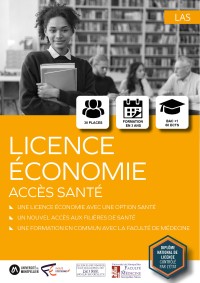
The advantages of the training program
- ACCESS TO HEALTH STUDIES
- MULTIDISCIPLINARY TRAINING
- EASIER REORIENTATION
Objectives
-
Offer a multidisciplinary university education combining a major (in this case, economics) with a minor in health, enabling students to acquire solid skills in both fields.
-
Ensure students acquire the fundamental knowledge of their major subject necessary to pursue bachelor's and master's degree programs.
-
Prepare students for the competitive entrance exam for health programs (MMOP) by developing rigorous work methods and high academic standards.
-
Develop analytical, scientific reasoning, and synthesis skills, which are essential in both economics and health disciplines.
Know-how and skills
The holder of the degree in Economics
- Prepares and collects the information needed to compile economic study files.
- Prepares the drafting of research reports: statistical or economic
- Follows up on the completion of studies entrusted to him/her
- Maintains relationships with customers and contacts on behalf of their employer
- Analyzes practices and assesses their compliance with regulations
- Monitors economic texts, procedures, and practices
- Participates in the implementation of management and decision-making support tools
He is proficient in
- Office software, information search, analysis, and synthesis techniques, communication techniques, business English. (Source: RNCP)
International dimension
Starting in their second year, students can spend a year (two semesters) at one of the 60 universities with which the Faculty of Economics has partnerships through the ERASMUS+ exchange programs, inter-university agreements, and CHARM-EU.
Organization
Knowledge assessment
The Bachelor's Degree in Economics, structured over three years and six semesters, is based on an assessment system designed to measure students' learning progressively and comprehensively. At the end of each semester, the skills, competencies, and knowledge acquired in each Teaching Unit (UE) are assessed in one of two ways: continuous assessment or a final exam.
Continuous assessment allows for regular monitoring of student progress through several forms of evaluation: supervised assignments, graded tutorials, presentations, projects, document analysis, and active participation in class. This method encourages attendance, regular work, and the gradual acquisition of skills.
The final exam consists of a written or oral test held at the end of the semester. It aims to assess the student's overall mastery of the concepts taught and their ability to apply their knowledge in a structured and in-depth manner.
Depending on the course units, teaching methods, or learning objectives, some units may combine both methods. These methods ensure fair, diverse assessment that is tailored to the nature of the teaching.
Special facilities
Students with disabilities, young entrepreneurs, and high-level athletes can benefit from personalized support.
This may take the form of study arrangements, educational adaptations, or specific rights, in order to enable them to best balance their personal or professional constraints with their university education. Depending on the situation, these measures may include an adapted schedule, adjusted assessment methods, attendance facilities, individualized monitoring, or dedicated support services.
Internships, supervised projects
Internship | Possible |
|---|---|
Duration of the internship | Maximum 924 hours, or 6 months |
Internship abroad | Possible |
A true immersion in the professional world, it allows students to apply the knowledge they have acquired in class, discover how organizations work, and compare theory with practice. To get the most out of it, serious preparation is essential: learning about the host organization, defining your objectives, mobilizing your skills, and preparing for professional demands.
During a bachelor's degree, internships are possible and optional. They must be related to the course of study.
The internship may begin at the end of the second semester exams or be completed during university vacation periods. In all cases, it must end no later than August 31, regardless of whether the student is enrolled in a Bachelor's degree, Master's degree, or University Diploma program.
Please note: students may only begin their internship immediately after the second semester exams if they have successfully completed their year in the first session.
Program
Licenses allowing access to health programs(LAS) arefirst-, second-, or third-year bachelor's degree programs that allow students to apply for admission to the second year of medical, midwifery, dentistry, or pharmacy studies (MMOP).
EU common health (prerequisite for MMOP application if ACQ)
12 creditsMedicines and Other Health Products (MAPS) 2 ECTS
2 creditsChoose 1 out of 4
Humanities and Social Sciences (HSS) 5 ECTS
5 creditsChoose 1 from 1
General Human Physiology (PHG) 5 ECTS
5 creditsChoose 1 from 1
Principles of economics
5 creditsPolitical Science
4 creditsLaw
4 creditsMathematics for Economists 1
5 creditsOptional
Contemporary economic issues
4 creditsMathematics and Statistics for Economists - 2 -
5 creditsLANGUAGE SELECTION 1
2 creditsChoose one of two options:
Spanish S2
2 creditsEnglish S2
2 credits
Statistics 1
5 creditsGeneral accounting
Macroeconomics 1
5 creditsMicroeconomics 1
5 creditsChoose 1 out of 3
Optional
Admission
Admission requirements
- For the LAS Bachelor's Degree: High school diploma or equivalent
Registration procedures
First year of a bachelor's degree
If you are in your final year of high school or wish to change direction for the start of the academic year in the first year of LAS, you must submit an application via Parcoursup between January and March. Admission offers and responses to applicants will be made on an ongoing basis between June and July.
Target audience
High school and college students from the Montpellier Academy, the Occitanie region, France, and internationally
Tuition fees
Tuition fees are set each year by the Ministry of Higher Education. They are accompanied by the Student and Campus Life Contribution (CVEC).
The entire program is free for students receiving scholarships.
Capacity
Recommended prerequisites
Possess mathematical and statistical skills essential to economics and management
Economics courses frequently use mathematical modeling to better understand the problems being studied and analyze the resulting findings in a logical manner. In addition, many careers in economics and management rely on the analysis of numerical data.
Know how to use written and oral communication skills and logical reasoning to argue a conceptual argument.
Economics courses require students to be able to produce structured arguments, even relatively simple ones (this skill is intended to be reinforced at university), and to reason about concepts. A bachelor's degree program requires a certain capacity for abstraction, formal logic, and deduction.
Jobs in economics often involve writing studies or reports that require structured argumentation, synthesis skills, and a good level of language proficiency.
Have a broad general knowledge
Economic thinking is informed by current economic, political, and societal events. Students must therefore be able to identify and understand the societal issues related to the topics covered during their studies.
Possess methodological and behavioral skills in order to be able to work independently and responsibly.
In a bachelor's degree program, students are responsible for their own education and success. They must therefore be able to organize their work, seek out the resources available to them, and find time for group work.
Have English language skills
There are many sectors of the economy where professional and academic documentation and business relations are based on English. Skills in this language are therefore essential.
And after
Continuing education
Continuing studies in LAS Economics:
Students who obtain 60 ECTS credits in LAS 1 (in the first or second session and with compensation between course grades) validate their first year and are admitted to LAS 2. In this case, students then follow a course outline that is strictly identical to the Bachelor's Degree in Classical Economics.
Courses in the Health Minor (if applicable, if they have not been obtained with an average grade of 10/20 each) are added to the 60 ECTS credits of the LAS 2 Economics program. The distinctive feature of the LAS Economics program compared to the traditional Economics Bachelor's degree is that it opens up the possibility of taking the MMOP competitive examination, which is not possible with the traditional Economics Bachelor's degree.
Students who do not obtain 60 ECTS credits in LAS 1 must repeat the year. In this case, students follow a course structure that is strictly identical to that of the Bachelor's degree in Classical Economics. It is not possible to take courses in the Health Minor while repeating LAS 1 or to apply for the MMOP competitive exam. Students who obtain their 180 ECTS credits in the LAS Bachelor's degree and who have not been admitted to the MMOP competitive exam may apply for any Master's program open to a Bachelor's degree in Classical Economics.