


ECTS
120 credits
Duration
2 years
Training Structure
School of Economics
Overview
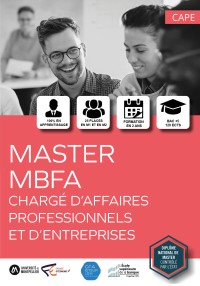
TheMaster’s in Professional and Corporate Account Management (CAPE) trains professional and corporate account managers to fulfill their responsibilities of managing, advising, and developing a client portfolio consisting of artisans, merchants, independent professionals, microbusinesses, and small and medium-sized enterprises, while taking into account developments in the banking and financial sectors and regulatory requirements.
This program provides a solid foundation in economic, banking, and financial analysis, as well as proficiency in quantitative and digital analytical tools, preparing students for careers in professional and corporate business centers.
The training program enables participants to acquire essential technical, business, and interpersonal skills, while developing a solid understanding of risk management—which is essential for advancing in this industry.
The Benefits of the Training Program
- 100% WORK-STUDY PROGRAM
- HIGH LEVEL OF SPECIALIZATION
- PARTNERSHIP WITH THE ÉCOLE SUPÉRIEURE DE LA BANQUE
Objectives
- Manage and develop a portfolio of business clients (retailers, artisans, independent professionals, microbusinesses and small and medium-sized enterprises)
- Understanding the Economic, Legal, and Tax Environment of the Banking and Insurance Sector
- Conduct an economic and financial assessment of a business client
- Contribute to the growth of your portfolio by offering products and services tailored to the needs of clients and prospects
- Manage risk exposure and operate in compliance with regulations
Expertise and Skills
Expertise
- Analyze complex economic and financial issues at various levels
- Implement a structured sales approach tailored to the needs of business customers
- Adopt the interpersonal and ethical behaviors essential to the profession.
- Present and highlight analysis results in writing and orally
- Master quantitative and econometric tools applied to economics and finance
Skills
- Master financial analysis and risk assessment techniques
- Expertise in the processing and analysis of economic and financial data
- Ability to analyze critically, synthesize information, and support decision-making
- Intellectual Independence and Methodological Rigor
- Professional Communication Skills and the Ability to Present Economic Arguments
Organization
Knowledge Assessment
Master’s programs at the School of Economics are structured over two years and four semesters and are based on an assessment system designed to measure students’ learning progress in a gradual and comprehensive manner. At the end of each semester, the skills, competencies, and knowledge acquired in each course unit (UE) are assessed in one of two ways: through continuous assessment or a final exam.
Continuous assessment allows for regular monitoring of student progress through various forms of evaluation: proctored exams, graded tutorials, presentations, projects, document analyses, and active participation in class. This approach encourages regular attendance, consistent work, and the gradual acquisition of skills.
The final exam, on the other hand, consists of a written or oral test administered at the end of the semester. Its purpose is to assess the student’s overall mastery of the concepts taught and their ability to apply their knowledge in a structured and in-depth manner.
Depending on the learning outcomes or educational objectives, some courses may combine both assessment methods. These approaches ensure fair, diverse, and appropriate assessment tailored to the nature of the course, while allowing students to develop methodological skills, rigor, and independence throughout their academic journey.
Open on an alternating basis
Contract Type | Apprenticeship Contract |
|---|
Apprenticeships are based on the principle of alternating between academic and practical instruction provided at the university and the acquisition of practical skills at a workplace. The frequency of this alternation varies depending on the program but follows a schedule established in advance.
The apprenticeship contract or professional training contract are special employment contracts that allow the student to hold dual status: as a student and as a full-fledged employee of the company.
MANDATORY INTERNSHIP IN M1 AND M2
Program
The program lasts 2 years, or 4 semesters
120 ECTS
Work-Study Program (Apprenticeship or Professional Training Contract)
DETAILS ON UPCOMING COURSE PROGRAMS
Bank Forecast
8 creditsMonetary and Financial Macroeconomics
3 creditsImplement an appropriate, enhanced relationship-building approach
8 creditsBanking and Financial English
2 creditsBanking Modeling
9 credits
Credit
2 creditsCorporate Finance
4 creditsAccount Opening and Related Services
4 creditsFinancial Mathematics Using Excel VBA
3 creditsInsurance
2 creditsSupporting clients through life events
2 creditsExpand the client portfolio and manage risks in
4 creditsSupervised Project
5 creditsBank Statement
2 creditsProfessional Review and Evaluation of the Internship Period
2 credits
Admission
Admission Requirements
- For the Master 1 program: Applicants must hold or be in the process of earninga bachelor’s degree (or equivalent, bac+3) in economics or banking and insurance, recognized in France or Europe.
- For the Master 2 program: Applicants must have completed at least 4 years of higher education (Bac +4 / 240 ECTS) in fields related to economics or similar disciplines. A strong academic record and, in some cases, professional experience are highly valued.
Registration Procedures
First year of the master's program
To apply for admission to the first year of the Master's program, you must submit your application on theMon Master platform and on the ESBanque website.
Second year of the master's program
To gain admission to the second year of the master's program based on academic equivalence, you must complete the ecandidat application process on the ESBanque website.
Target Audience
Students from the Montpellier Academy, the Occitanie region, France, and abroad
Tuition Fees
Tuition fees are set each year by the Ministry of Higher Education. They are accompanied by the Student and Campus Life Contribution (CVEC). Students receiving scholarships are exempt from paying these fees.
Capacity
Recommended Prerequisites
A strong background in mathematics, statistics, financial analysis, and econometrics is essential. Professional experience (work-study program, internship, summer job) in banking, insurance, or finance can strengthen your application.