

ECTS
120 credits
Duration
2 years
Training structure
Faculty of Economics
Presentation
OPENING SEPTEMBER 2026
TheMaster's in Professional and Corporate Affairs (CAPE) trains economists to analyze, evaluate, and design public and private economic policies in national and international contexts, taking into account developments in the banking and financial sector and regulatory constraints.
The program is based on anin-depth mastery of the theoretical and empirical tools of economic analysis, supplemented by courses in applied econometrics, finance, risk management, and data analysis. It enables students to develop a detailed understanding of economic and financial mechanisms, as well as modeling and decision-making skills tailored to the needs of organizations.
This master's degree is intended for students who wish to acquire advanced analytical skills, a strong intellectual independence and one ability to produce rigorous economic diagnoses, which can be applied in the fields of consulting, economic and financial analysis, as well as in business development roles working with professionals and companies.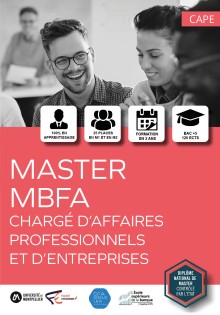
The advantages of the training program
- 100% WORK-STUDY PROGRAM
- STRONG SPECIALIZATION
- PARTNERSHIP WITH ESB
Objectives
-
Training specialists in economic policy analysis and evaluation
-
Mastering quantitative and econometric tools applied to economics and finance
-
Develop critical analysis, modeling, and forecasting skills
-
Prepare for professional integration or doctoral studies
Know-how and skills
Know-how
-
Analyze complex economic and financial issues at different levels
-
Design and apply economic and econometric models
-
Collect, use, and analyze economic and financial databases
-
Conduct studies, economic analyses, and reports to aid decision-making
-
Use IT and statistical tools suited to economic and financial analysis
-
Present and promote analysis results in writing and orally
Skills
-
Mastery of the theoretical and empirical foundations of economic analysis
-
Modeling and quantitative analysis skills applied to economics and finance
-
Expertise in the processing and analysis of economic and financial data
-
Ability to analyze critically, synthesize, and assist in decision-making
-
Intellectual independence and methodological rigor
-
Ability to communicate professionally and present economic arguments
Organization
Knowledge assessment
The Master's programs at the Faculty of Economics are structured over two years and four semesters, based on an assessment system designed to measure students' learning progressively and comprehensively. At the end of each semester, the skills, competencies, and knowledge acquired in each Teaching Unit (UE) are assessed in one of two ways: continuous assessment or a final exam.
Continuous assessment allows for regular monitoring of student progress through several forms of evaluation: supervised assignments, graded tutorials, presentations, projects, document analysis, and active participation in class. This method encourages attendance, regular work, and the gradual acquisition of skills.
The final exam consists of a written or oral test held at the end of the semester. It aims to assess the student's overall mastery of the concepts taught and their ability to apply their knowledge in a structured and in-depth manner.
Depending on the course units, teaching methods, or learning objectives, some units may combine both assessment methods. These methods ensure fair and diverse assessment that is tailored to the nature of the course, while allowing students to develop methodology, rigor, and autonomy throughout their academic career.
Open alternately
Apprenticeships are based on the principle of alternating between academic and practical training at university and acquiring skills with an employer. The pace of this alternation varies depending on the program, but follows a schedule established in advance.
The apprenticeship contract is a special employment contract that allows students to benefit from dual status: student and full-time employee of the company.
MANDATORY INTERNSHIPS IN M1 AND M2
Program
The program lasts two years, or four semesters.
120 ECTS
Initial and continuing education
DETAILS OF UPCOMING COURSE PROGRAMS
Admission
Admission requirements
- For Master's 1: Holder of or currently pursuinga bachelor's degree (or equivalent, three years of higher education) in economics or a similar field, recognized in France or Europe.
- For the Master 2: Have completed at least 4 years of higher education (Bac +4 / 240 ECTS) in fields related to economics or similar. A strong academic record and, in some cases, professional experience are valued.
Registration procedures
First year of master's degree
To apply for admission to Master 1, you must submit your application on theMon Master platform.
Second year of master's degree
To gain equivalent access to the second year of the master's program, the ecandidat procedure is mandatory.
Target audience
Students from the Montpellier Academy, the Occitanie region, France, and internationally
Tuition fees
Tuition fees are set each year by the Ministry of Higher Education. They are accompanied by the Student and Campus Life Contribution (CVEC). Both are exempt for students receiving scholarships.
Capacity
Recommended prerequisites
A good level inmicroeconomics, macroeconomics, mathematics, statistics, and econometrics is essential. Depending on the desired career path, certain options may be valued.
And after
Continuing education
Master's degree graduates can continue their studies, particularlyin economics, in France or abroad, especially those who are interested in research or higher education. Additional specialized training (university degrees) may also be considered depending on career plans.
Professional integration
-
Economic Research Officer
-
Economic or financial analyst
-
Public or economic policy consultant
-
Economist in public institutions, banks, insurance companies, or international organizations
-
Doctoral studies in economics