

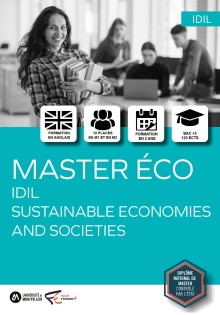
ECTS
120 credits
Duration
2 years
Training Structure
School of Economics
Language(s) of Instruction
English
Overview
The Sustainable Economies and Societies track is part of the IDIL (Interdisciplinary In Lab) graduate program at the University of Montpellier, which brings together top-tier programs based on research and interdisciplinarity. Taught in English at the Faculty of Economics, this master’s program aims to train students to analyze and support the economic and social transformations associated with the major challenges of sustainability.
The program is fully aligned with the University of Montpellier’s thematic priorities: Nourish, Care, and Protect. It offers an interdisciplinary approach to economic research, structured around the design, implementation, and evaluation of public policies.
The In-Lab pedagogical approach places students at the center of research projects conducted in collaboration with laboratories and in interaction with socioeconomic stakeholders. This approach encourages experimentation, work in multidisciplinary teams, and learning through research.
Open to an international audience, the program prepares students for both doctoral studies and professional careers in the private sector or in public and private organizations. Particular emphasis is placed on sustainable development and innovation policies, in connection with territorial and societal transitions.
The Benefits of the Training Program
- ENGLISH TRAINING
- INTERDISCIPLINARITY
- DIVERSITY OF CAREER OPPORTUNITIES
Objectives
- Understand and analyze the economic and social transformations related to sustainability.
- Adopt an interdisciplinary approach and develop skills in economic modeling and analysis.
- Acquire skills through research projects conducted in research laboratories (“#In-Lab#”).
- Prepare students for research (Ph.D.) and careers in sustainable development, innovation, and societal transitions.
Expertise and Skills
Expertise
- Apply quantitative and qualitative research methods in economics.
- Develop economic analyses of sustainability issues.
- Design and manage interdisciplinary projects in collaboration with socioeconomic stakeholders.
- Work as part of a multidisciplinary team and communicate results effectively.
Skills
- Ability to understand and solve complex problems related to sustainable development and innovation.
- Proficiency in tools and methods for evaluating public policies and regional projects.
- Ability to adapt to international and interdisciplinary contexts.
- Preparation for research (Ph.D.) and professional careers in business and other organizations.
International Dimension
This program is taught entirely in English. This allows students to enrich their education and actively participate in research projects conducted in laboratories and in collaboration with the teams’ and the university’s international partners. With the goal of making the University of Montpellier’s programs more attractive to international students, a financial aid program has been established to support the enrollment of international students.
Organization
Knowledge Assessment
The Master’s program at the Faculty of Economics is structured over two years and four semesters and is based on an assessment system designed to measure students’ learning progress in a gradual and comprehensive manner. At the end of each semester, the skills, competencies, and knowledge acquired in each course (UE) are assessed in one of two ways: through continuous assessment or a final exam.
Continuous assessment allows for regular monitoring of student progress through various forms of evaluation: proctored exams, graded tutorials, presentations, projects, document analyses, and active participation in class.
The final exam, on the other hand, consists of a written or oral test administered at the end of the semester. Its purpose is to assess the student’s overall mastery of the concepts taught and their ability to apply their knowledge in a structured and in-depth manner.
Special Features
Students with disabilities, young entrepreneurs, and elite athletes can receive personalized support.
This may take the form of academic accommodations, pedagogical adjustments, or specific rights, in order to enable students to best balance their personal or professional commitments with their university studies. Depending on the situation, these measures may include an adapted class schedule, modified assessment procedures, attendance accommodations, individualized support, or dedicated support services.
Internships, supervised projects
Internship | Required |
|---|---|
Duration of the internship | A maximum of 924 hours, or 6 months |
The primary objective is to train students through research and for research in laboratories affiliated with the University of Montpellier. Six-month internships are planned for this purpose, not only to introduce students to the research environment as early as possible, but also to enable them to learn some of the concepts typically covered in class by working alongside researchers.
All internships for the first and second years of the master's program are paid.
In addition to this program, “In Lab” teaching sessions—led by research teams over the course of a few days—are held in the laboratories to provide an immersive learning experience focused on a specific technique, method, or concept.
Program
Ecological Crisis and the Dynamics of Change - 1
3 creditsIn-Lab
2 creditsEnvironmental and Resource Economics - 1
3 creditsPersonal project: research project + English
10 creditsOptional
EU NON-CORE TRAINING UNITS IDIL (ELECTIVE)
2 creditsChoose 1 out of 11
Economic Insights into Sustainable Development
3 creditsDefusing Quantitative Nonsense
2 creditsPlant Health 2.0: A Global War
2 creditsInnovations in clinical biomarkers and biotechnologies for pers
2 creditsOne Health and Eco-Epidemiology
2 creditsMediterranean Terrestrial Ecosystems
2 creditsScientific Openness to Earth and Water Issues in a Global Context
2 creditsThe Bionic Man
2 creditsBasics of Sustainable Management
2 credits20hChallenges in Chemistry for Health and the Environment
2 creditsWhy Is Democracy Hard?
2 credits
Promoting Innovation in Digital Health Technology 1
3 creditsEmpirical Methods in Economics: Econometrics of Qu
3 creditsIDIL Cross-Functional Training Units
4 credits
EU Research Internship
30 credits
Admission
Admission Requirements
- For the Master 1 program: Applicants must hold or be in the process of earninga bachelor’s degree (or equivalent, bac+3) in economics or a related field, recognized in France or Europe.
- For the Master 2 program: Applicants must have completed at least 4 years of higher education (Bac +4 / 240 ECTS) in fields related to economics or similar disciplines. A strong academic record and, in some cases, professional experience are highly valued.
Registration Procedures
First year of the master's program
To apply for admission to the first year of the Master's program, you must submit your application through theMon Master platform.
Second year of the master's program
To gain admission to the second year of the master's program based on academic equivalence, the ecandidat application process is required.
economie.edu.umontpellier.fr/candidatures/candidatures-et-admissions/
Target Audience
Students from the Montpellier Academy, the Occitanie region, France, and abroad
Tuition Fees
Tuition fees are set each year by the Ministry of Higher Education. They are accompanied by the Student and Campus Life Contribution (CVEC). Students receiving scholarships are exempt from paying these fees.
Capacity
And then
Continuing Education
The program prepares students for both immediate entry into the workforce and further study toward a doctoral degree, which is possible under certain conditions.
Employment Placement
- Ecological Transition and Sustainable Development
: Local governments, public agencies, NGOs, consulting firms. - Businesses and CSR/ESG
: Large corporations, consulting firms, sustainable finance. - Economic Analysis and Public Policy
: Public institutions, think tanks, international organizations. - Cooperation and International Organizations
: Projects related to climate, development, and inequality. - Research and Ph.D.
In economics, sustainable development, or the social sciences.
Possible Careers
- Sustainable Development Project Manager
- Ecological Transition Project Manager
- CSR/ESG Project Manager
- Economic or Socioeconomic Analyst
- Public Policy Researcher or Evaluator
- Junior Sustainability Consultant