
ECTS
120 credits
Duration
2 years
Training Structure
School of Economics
Language(s) of Instruction
French
Overview
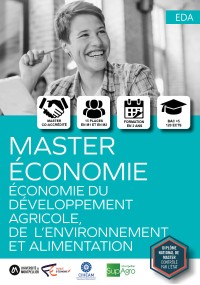
The Agricultural Development, Environment, and Food Economics track is designed for students who wish to pursue a research-based education focused primarily on economic analysis, while also incorporating complementary courses in management sciences and economic sociology.
This master’s program aims to prepare students to take on roles that require autonomy, initiative, and a thorough understanding of economic reasoning. It focuses on imparting the fundamental theoretical and methodological knowledge of contemporary economic analysis.
The program places a strong emphasis on the use of advanced modeling and quantification techniques, as well as approaches drawn frominstitutional economics and management sciences. Through the various specializations offered, the program also enables students to acquire in-depth expertise applicable to numerous sectors of the economy, paving the way for both academic research and careers in consulting and analysis.
The Benefits of the Training Program
- A MULTIDISCIPLINARY APPROACH
- SOLID EXPERTISE
- A WIDE RANGE OF CAREER OPPORTUNITIES
Objectives
- To prepare students, through high-level research and teaching, for a variety of professional careers in the field of research and applied economic and management studies related to development in the agricultural, agri-food, and rural sectors.
- The professional leadership positions targeted by this master's program generally require the ability to handle tasks.
- This Research Master's program is designed for students who wish to gain research-based training for roles that require autonomy, initiative, and a strong foundation in economics.
- Focused on imparting fundamental theoretical and methodological knowledge, the program places significant emphasis on the use of advanced modeling and quantification techniques in contemporary economic analysis, as well as on approaches from institutional economics and management sciences.
- At the same time, it allows students to gain in-depth expertise in a wide range of economic sectors through the various specializations offered.
Expertise and Skills
Expertise
-
Analyze complex issues related to agricultural development,the environment, andfood using economic tools.
-
Designing and conducting a research project: formulating research questions, reviewing the literature, selecting research methods, and analyzing and interpreting results.
-
Apply advanced quantitative methods (statistics, econometrics, modeling) to economic analysis.
-
Use qualitative and institutional approaches to analyze the behaviors of stakeholders and organizational dynamics.
-
Evaluate public policies, development programs, or projects related to the agricultural, food, and environmental sectors.
-
Write analytical reports, summary notes, and scientific papers.
-
Present and defend research findings orally, in French and/or English.
Skills
-
Proficiency in the theoretical foundations of development economics, agricultural economics, environmental economics, and food economics.
-
Ability to integrate economic analysis, management sciences, and economic sociology.
-
Independence in the collection, processing, and analysis of economic and socioeconomic data.
-
A critical mindset and the ability to take a step back and evaluate results and the methods used.
-
Ability to work independently or as part of a team in multidisciplinary settings.
-
Ability to take initiative, organize, and manage complex projects.
-
Transferable skills for careers in research,economic analysis, consulting, andpublic policy analysis.
International Dimension
Starting in their second year, students can spend a year (two semesters) at one of the 60 universities with which the School of Economics has partnerships through the ERASMUS+, inter-university agreements, and CHARM-EU exchange programs.
https://economie.edu.umontpellier.fr/international/
Organization
Knowledge Assessment
The Master’s program at the School of Economics, which is structured overtwo years and four semesters, is based on an assessment system designed to measure students’ learning progress in a gradual and comprehensive manner. At the end of each semester, the skills, competencies, and knowledge acquired in each course (UE) are assessed in one of two ways: through continuous assessment or a final exam.
Continuous assessment allows for regular monitoring of student progress through various forms of evaluation: proctored exams, graded tutorials, presentations, projects, document analyses, and active participation in class. This approach encourages regular attendance, consistent work, and the gradual acquisition of skills.
The final exam, on the other hand, consists of a written or oral test administered at the end of the semester. Its purpose is to assess the student’s overall mastery of the concepts taught and their ability to apply their knowledge in a structured and in-depth manner.
Special Features
Students with disabilities, young entrepreneurs, and elite athletes can receive personalized support.
This may take the form of academic accommodations, pedagogical adjustments, or specific rights, in order to enable students to best balance their personal or professional commitments with their university studies. Depending on the situation, these measures may include an adapted class schedule, modified assessment procedures, attendance accommodations, individualized support, or dedicated support services.
Internships, supervised projects
Internship | Possible |
|---|---|
Duration of the internship | A maximum of 924 hours, or 6 months |
Internship Abroad | Possible |
An internship offers a true immersion in the professional world, allowing students to apply the knowledge they’ve gained in class, learn how organizations operate, and compare theory with practice. To get the most out of it, thorough preparation is essential: learn about the host organization, set your goals, draw on what you’ve learned, and prepare for professional demands.
All Master's programs offer the opportunity to complete an internship.
In the first year of the master's program, an internship is possible but optional. It must be related to the program.
The internship may begin at the end of the second-semester exams or take place during university breaks. In any case, it must end no later than August 31, regardless of whether the student is enrolled in a Bachelor’s program, a first-year Master’s program, or a University Diploma program.
In the second year of the Master's program, the internship is required
The start date is set in consultation with the academic advisor, generally between February and March, to align with the academic calendar and the requirements for the final thesis. Regardless of the period chosen, the internship mustend no later than September 30.
economie.edu.umontpellier.fr/carriere/partir-en-stage/
Program
Choose one of the following two options:
Optional
Agricultural Economics and Agricultural Policy
4 creditsProject Management and Financial Evaluation
3 creditsEconometrics
Introduction to R Software
Environmental Economics
Individual Research Project
Public Economics
3 creditsSurvey Methods
Statistical Software / Stata
Choose one of the following two options:
Optional
Corporate Social Responsibility
4 creditsThe Economics of Risk and Uncertainty
Excel / Power BI
3 creditsNatural Resource Governance
4 creditsEconometrics of Qualitative Variables
Individual Research Project
5 creditsData Analysis
3 creditsBehavioral Economics
UE1 Core Curriculum
3 creditsUE3 Specialized Course 1
Choose 3 or 4 out of 4
UE2 Methodology Courses
Choose 3 out of 4
UE4 Specialized Course 2
Choose 3 out of 5
Thesis
22 creditsCHOICE 1
10 creditsChoose 2 out of 4
Seminar 1 (Supagro)
2 creditsSeminar 3
2 creditsSeminar 4
2 creditsSeminar 2 (Supagro)
2 credits
Research Support TD (Supagro)
Admission
Admission Requirements
- For the Master 1 program: Applicants must hold or be in the process of earninga bachelor’s degree (or equivalent, bac+3) in economics or a related field, recognized in France or Europe.
- For the Master 2 program: Applicants must have completed at least 4 years of higher education (Bac +4 / 240 ECTS) in fields related to economics or similar disciplines. A strong academic record and, in some cases, professional experience are highly valued.
Registration Procedures
First year of the master's program
To apply for admission to the first year of the Master's program, you must submit your application through theMon Master platform.
Second year of the master's program
To gain admission to the second year of the master's program based on academic equivalence, the ecandidat application process is required.
economie.edu.umontpellier.fr/candidatures/candidatures-et-admissions/
Target Audience
Students from the Montpellier Academy, the Occitanie region, France, and abroad
Tuition Fees
Tuition fees are set each year by the Ministry of Higher Education. They are accompanied by the Student and Campus Life Contribution (CVEC). Students receiving scholarships are exempt from paying these fees.
Capacity
And then
Continuing Education
The program prepares students for both immediate entry into the workforce and further study toward a doctoral degree, which is possible under certain conditions.
Employment Placement
Graduates with this degree are qualified to assume management roles in companies, public agencies, and nonprofit organizations operating in the environmental, agricultural, and agri-food sectors. They are proficient in the use of statistical and computational tools in economics and possess the ability to model and process data.
Graduates of the Master's in Economics with a specialization in Agricultural Development, Environmental, and Food Economics work in the following sectors:
- At the university. Higher education in agriculture or economics; major public applied research organizations: INRA, CIRAD, IRD, IRSTEA, CNRS, IFREMER
- In engineering and design firms, large international organizations, nongovernmental organizations (NGOs), the research and development departments of large companies, local governments, and certain public or quasi-public agencies
- In banks, insurance companies, and large industrial and commercial firms in the sector
- In the French and European civil service (after passing a competitive examination)
Generally speaking, graduates of the EcoDEVA Master's program hold executive positions in the public or private sector.
He or she may hold the following positions: Local Development Advisor, Analysis and Development Specialist, Research Analyst, Project Manager, Economic Consultant, Economic Engineer or Statistician, Professor/Researcher, Researcher.
His degree makes him an expert in environmental and natural resource economics, as well as agricultural and agri-food development.
https://osipe.edu.umontpellier.fr/masters/