


ECTS
60 credits
Duration
3 years
Training Structure
School of Economics, School of Law and Political Science
Language(s) of Instruction
French
Overview
The dual degree program in Economics and Political Science is a selective program with limited enrollment offered by the University of Montpellier. With a distinctly multidisciplinary focus, it addresses contemporary challenges and the needs of emerging professions, particularly in the fields of the environment, energy, governance, decision support, and the development of projects with a national or international scope.
This program providesstudents with a solidfoundation inboth economics and political science—and, more broadly, in the social sciences—and helps them develop the ability to analyze political and economic institutions and dynamics. It thus prepares students to take on leadership roles in both the public and private sectors, in France and internationally.
Students take the core courses for both bachelor’s degree programs: economics and political science. This integrated curriculum ensures a rigorous and coherent education, culminating in a comprehensive oral exam that highlights how the two fields complement each other in understanding the contemporary world.
The dual expertise gained opens the door to the best master’s programs in each discipline, as well as to multidisciplinary master’s programs geared toward careers of the future.
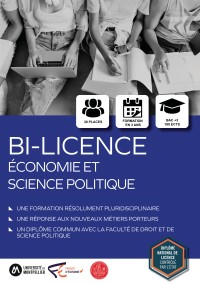
The Benefits of the Training Program
- A MULTIDISCIPLINARY EDUCATION
- NEW, PROMISING CAREERS
- A JOINT DEGREE IN ECONOMICS AND POLITICAL SCIENCE
Objectives
-
Gain a solid dual expertise in economics and political science
-
Develop the ability to analyze contemporary issues (economic, political, institutional, and social) from a multidisciplinary perspective
-
Understanding National and International Governance and Regulatory Dynamics
-
Strengthen tools for decision-making and the evaluation of public policies
-
Combining social science approaches to analyze complex situations
-
Prepare students for admission to selective master’s programs in economics, political science, or interdisciplinary tracks
-
To train individuals for leadership roles in the public and private sectors, both in France and internationally
Expertise and Skills
Expertise
-
Jointly harnessing the tools of economics and political science
-
Analyze a complex economic, institutional, or political situation
-
Analyzing Quantitative and Qualitative Data
-
Develop an assessment and formulate well-reasoned recommendations
-
Evaluating Public Policies and Regulatory Measures
-
Prepare summary notes and analytical reports
-
Presenting a problem orally in an interdisciplinary setting
-
Working in a project-based environment and as part of a multidisciplinary team
Skills
-
Double Major in Economics and Political Science
-
Mastery of key concepts in the social sciences
-
Ability to analyze critically and put things into perspective
-
Understanding Institutions and Governance Mechanisms
-
Methodological rigor and the ability to synthesize information
-
Independence in Work and Organization
-
Writing and Argumentation Skills
-
Ability to make informed decisions and demonstrate expertise
International Dimension
Starting in their second year, students can study at one of the 60 universities with which the School of Economics has partnerships through the ERASMUS+, inter-university exchange agreements, and CHARM-EU exchange programs.
Organization
Knowledge Assessment
The dual-degree program at the University of Montpellier, structured over three years and six semesters, is based on an assessment system designed to measure students’ learning progress in a gradual and comprehensive manner. At the end of each semester, the skills, competencies, and knowledge acquired in each course unit (UE) are assessed in one of two ways: through continuous assessment or a final exam.
Continuous assessment allows for regular monitoring of student progress through various forms of evaluation: proctored exams, graded tutorials, presentations, projects, document analyses, and active participation in class. This approach encourages regular attendance, consistent work, and the gradual acquisition of skills.
The final exam, on the other hand, consists of a written or oral test administered at the end of the semester. Its purpose is to assess the student’s overall mastery of the concepts taught and their ability to apply their knowledge in a structured and in-depth manner.
The program also includes a major interdisciplinary oral exam. This cross-disciplinary exam requires students to draw on both economics and political science to analyze a contemporary issue.
It assesses students’ abilities in synthesis, argumentation, interdisciplinary analysis, and oral presentation. This major oral presentation is a highlight of the program and validates the coherence of the dual set of skills acquired.
Special Features
Students with disabilities, young entrepreneurs, and elite athletes can receive personalized support.
This may take the form of academic accommodations, pedagogical adjustments, or specific rights, in order to enable students to best balance their personal or professional commitments with their university studies. Depending on the situation, these measures may include an adapted class schedule, modified assessment procedures, attendance accommodations, individualized support, or dedicated support services.
Internships, supervised projects
Internship | Possible |
|---|
A true immersion in the professional world, it allows students to apply the knowledge they have acquired in class, discover how organizations operate, and compare theory with practice.
During the bachelor's degree program, internships are available but optional. They must be related to the program of study.
The internship may begin after the second-semester exams or take place during university breaks. In any case, it must end no later than August 31.
Please note: The internship cannot begin immediately after the second-semester exams unless the student has successfully completed the academic year during the first exam session.
Program
The program lasts 3 years, or 6 semesters
180 ECTS
EU English 1
Business Economics
5 creditsPrinciples of Economics
5 creditsEU History of the Social Sciences
History of Economic Events
5 creditsMathematics for Economists 1
5 creditsEU International Relations
3 creditsEU Introduction to Political Science 1
4 creditsEU French Politics 1
4 creditsOptional
EU English 2
Macroeconomics 1
5 creditsStatistics 1
5 creditsMicroeconomics 1
5 creditsEU Constitutional Law of the Fifth Republic
EU Administrative Institutions
EU Introduction to Political Science 2
4 creditsEU Political Life Under the Fifth Republic
4 creditsContemporary Economic Issues
4 creditsOptional
Optional
Microeconomics 2
6 creditsEU Political Communication
3 creditsEnglish S3
2 creditsEU Historical Sociology of the State
4 creditsMacroeconomics 2
6 creditsEU Mobilizations and Social Movements
4 creditsDevelopment Institutions
2 creditsStatistics 2
5 creditsEU General Education 1: Major Political and Social Issues
Optional
Mathematics and Statistics for Economists - 2 -
5 creditsGeneral Education Course 2: Current Events Lectures
EU Western Political Systems 1
4 creditsEnglish S4
2 creditsMacroeconomics 3
6 creditsEU Political Theory
EU Great Classics of Sociology 1
3 creditsEconomic Demographics
Microeconomics 3
6 creditsESP Demographics
3 creditsESP Mathematics and Statistics for Economists 2
4 credits
Optional
EU: Major International Issues
4 creditsEU Introduction to Public Policy
6 creditsHistory of Economic Thought
4 creditsPreparation for the Grand Oral 1
2 creditsApplied Economics
2 creditsEU Dictatorships
3 creditsIndustrial Organization
English S5
2 creditsIn-Depth Analysis of Contemporary Economic Issues
3 creditsEU Political Science of Europe
Financial Analysis
4 creditsEU Western Political Systems 2
6 creditsEnglish S6
2 creditsInternational Economics
4 creditsEU General Education 3: Contemporary Political Issues
EU Great Classics of Sociology 2
3 creditsDatabase
4 creditsEpistemology of the Social Sciences
2 creditsPreparation for the Grand Oral 2
4 creditsEconomic and Social Policy
5 creditsOptional
Admission
Admission Requirements
Admission Requirements
- For the Dual Degree Program 1: High school diploma or equivalent
Registration Procedures
Registration Procedures
First Year of the Bachelor's Degree in Economics and Political Science
If you are in your senior year of high school or wish to change your academic path for the start of your freshman year, you must submit an application through Parcoursup between January and March. Admission offers and responses to applicants will be sent out on a rolling basis between June and July.
2nd and 3rd Years of the Bachelor's Degree in Economics and Political Science
To gain admission to the 2nd or 3rd year through course equivalency, theecandidat application processis required.
economie.edu.umontpellier.fr/candidatures/candidatures-et-admissions/
Target Audience
The target audience for the Economics–Political Science bachelor’s degree program consists of students with strong academic potential who are curious about contemporary economic, political, and institutional issues and eager to pursue a challenging and selective program of study.
This program is designed for students interested in the social sciences, the analysis of public policy and economic transformations, who possess strong reasoning, writing, and argumentation skills, as well as proficiency with quantitative tools. It is particularly well-suited for candidates who wish to acquire a structured dual expertise rather than a single-discipline background, aim to pursue selective master’s programs, and pursue careers in expert analysis, strategy, or leadership roles in the public and private sectors, both in France and internationally.
Tuition Fees
Tuition fees are set each year by the Ministry of Higher Education. They are accompanied by the Student and Campus Life Contribution (CVEC).
The entire program is free for students receiving scholarships.
Capacity
Recommended Prerequisites
Applications for admission to the first year of a bachelor's degree program are reviewed by an admissions committee
- Grades from 11th grade, 12th grade, and the baccalaureate (preliminary and final exams)
- Common Core Curriculum: French; Philosophy; History and Geography; Moral and Civic Education; Modern Languages; Science and Digital Humanities
- Specialized Fields: History, Geography, Geopolitics, and Political Science; Economics and Social Sciences; Humanities, Literature, and Philosophy; Mathematics; Foreign Languages and Literatures; Digital Technology and Computer Science
- Elective Courses: Law and Major Issues in the Contemporary World; Modern Language 3
- Future Profile
- Consistency of the Training Program
And then
Continuing Education
The dual expertise gained through this program is designed to facilitate access to the top master’s programs in each of the two disciplines, as well as to multidisciplinary master’s programs jointly accredited in political science and economics, in order to prepare students for rapidly evolving careers and the emerging needs of the job market.
About 90% of students continue their studies after earning a bachelor's degree (primarily in master's programs).