

Training Structure
College of Sciences
Program
Background and Energy Challenges
2 creditsDevelopment of Thin Films for Devices
2 creditsProfessional Projects – Project Management
8 creditsMethodology for Characterizing Materials
2 creditsPolymers
2 creditsThermodynamics and Phase Equilibria
2 creditsOptical and Electronic Properties
3 creditsAdvanced Inorganic Materials
2 creditsCommunication and Career Integration
2 creditsBasics of Radioactivity
2 creditsElectrochemistry
3 credits
Structure and Microstructure of Solids
2 creditsPractical Course: Materials and Energy
2 creditsPhotovoltaics - Solar Energy
2 creditsThe Fuel Cycle: From Mine to Waste Management
2 creditsThermal Properties of Materials
2 creditsTP Materials
2 creditsShaping Solid Materials
2 creditsMechanical Properties of Materials
2 creditsInternship (2–4 months)
10 creditsHydrogen vector
3 creditsElectrochemical Storage
2 credits
Background and Energy Challenges
ECTS
2 credits
Training Structure
College of Sciences
Development of Thin Films for Devices
ECTS
2 credits
Training Structure
College of Sciences
Professional Projects – Project Management
Level of Education
4-year college degree
ECTS
8 credits
Training Structure
College of Sciences
Time of year
Fall
The professional project bridges the gap between traditional practical work and laboratory or industry internships. It takes the form of a supervised project in which students are placed in a professional setting through collaborative (group) work based on the completion of a project addressing a problem identified by a company, local government, nonprofit organization, or academic institution. It is part of the core curriculum of the Master’s in Chemistry and is carried out under the supervision of a faculty member or industry professional serving as a mentor. Conducted throughout the semester, this project aims to integrate and reinforce the knowledge and skills acquired during the undergraduate and early Master’s programs through this professional scenario. These real-world scenarios will be directly related to the Master’s track chosen by the students. In addition to disciplinary skills in chemistry, students will also acquire interpersonal, organizational, and communication skills—which are intrinsically linked to project management—thereby equipping them for their future professional careers.
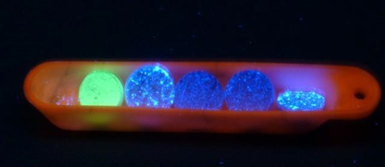
Addressing a research problem: an example of the synthesis of new phosphorescent materials.
Hourly volumes*:
CM: 5 hours
TD: 5 hours
Practical Training: 40 hours
Methodology for Characterizing Materials
Level of Education
4-year college degree
ECTS
2 credits
Training Structure
College of Sciences
Time of year
Fall
The syllabus for this course unit focuses on describing the principles and applications of the main methods used for the structural characterization of solids, thin films, surfaces, and interfaces, as well as several examples of their applications in materials chemistry. It covers the following techniques.
- Introduction to Solid-State NMR (NMR Signals, Interactions in Solid-State NMR, Magic-Angle Rotation, NMR Sequences, Cross-Polarization, Instrumentation, etc.)
- Electron microscopy: principles and applications of scanning and transmission electron microscopy and related techniques (EDS microanalysis).
- Spectroscopic methods: Raman spectroscopy, photoelectron spectroscopy, X-ray spectroscopy (XAS, XRF, etc.), Mössbauer spectrometry.
Hourly volumes*:
CM: 10 a.m.
TD: 10 a.m.
Polymers
Level of Education
4-year college degree
ECTS
2 credits
Training Structure
College of Sciences
Time of year
Fall
Polymers are all around us: we eat them, we wear them, and we build extremely complex structures out of them. From mature technologies to the most innovative materials, polymers are a crucial building block for shaping the world of tomorrow. In this course, we will cover several topics, including the controlled synthesis of polymers and cross-linked materials, surface modification using polymers, some characterization tools suited for polymers, and, finally, a section on the latest advances involving polymers.
Hourly volumes*:
CM: 1:00 p.m.
TD: 7:00 a.m.
Thermodynamics and Phase Equilibria
Level of Education
4-year college degree
ECTS
2 credits
Training Structure
College of Sciences
Time of year
Fall
- Review of the thermodynamics of single-component systems.
- Fundamentals of thermodynamics for multicomponent systems. Chemical potential, the Gibbs-Duhem relation, variance.
- Overview of thermal analysis techniques used to construct binary and ternary phase diagrams: ATG, ATD, and DSC
- Construction and interpretation of binary phase diagrams based on thermodynamic variables. Gibbs free energy, pressure, and temperature diagrams as functions of the composition of the binary mixture. Liquid-liquid, liquid-vapor, and solid-liquid mixtures.
- Phase transitions: first- and second-order transitions, critical points. Examples.
- The supercritical state: definition, thermodynamic properties, and the most widespread industrial applications.
- Construction and interpretation of ternary phase diagrams: variance, definitions of ternary eutectics, first- and second-order peritectics, isothermal sections, and study of alloy cooling.
Hourly volumes*:
CM: 13
TD: 7
Optical and Electronic Properties
ECTS
3 credits
Training Structure
College of Sciences
Advanced Inorganic Materials
Level of Education
4-year college degree
ECTS
2 credits
Training Structure
College of Sciences
Time of year
Fall
The HAC720C module covers “advanced inorganic materials” in five main sections. Thefirst section is devoted to general principles of inorganic materials and addresses structure-property relationships; particular attention is given to chemical bonding, the real crystal, and polycrystalline solids; the various classes of inorganic materials are described. Thesecond part focuses on ceramic materials (definitions and properties) and their synthesis (raw materials, including clays; shaping; drying and debinding; sintering); a distinction is made between traditional ceramics and technical ceramics (synthesis routes for oxide and non-oxide ceramics). Part3 covers glasses (classification and synthesis methods) and glass-ceramics (devitrification and soft chemistry); their properties and applications are also discussed. Part4 is dedicated to metals: properties of metals and metal alloys; metal nanoparticles; and catalytic materials. Part5 is devoted to inorganic materials developed for energy applications; ceramics (oxide and non-oxide; nanostructured) and metal hydrides are described (properties and synthesis) through several examples and in the context of their applications (batteries, hydrogen storage, and carbon dioxide capture).
Hourly volumes*:
CM: 1:00 p.m.
TD: 7:00 a.m.
Communication and Career Integration
ECTS
2 credits
Training Structure
College of Sciences
Basics of Radioactivity
Level of Education
4-year college degree
ECTS
2 credits
Training Structure
College of Sciences
Time of year
Fall
This course covers the various fundamental elements necessary for understanding natural and artificial radioactive phenomena. The goal is to establish a comprehensive understanding of concepts related to radioactive decay, natural radioactive families and their associated environmental impacts, dating methods, methods for producing radionuclides and their applications in various fields, as well as anthropogenic contributions. Various examples from fields such as industry, nuclear energy, radiochemistry, geochemistry, and nuclear medicine will be used to illustrate the basic concepts covered.
Hourly volumes*:
CM: 12:00 p.m.
TD: 8:00 a.m.
Electrochemistry
ECTS
3 credits
Training Structure
College of Sciences
Structure and Microstructure of Solids
ECTS
2 credits
Training Structure
College of Sciences
Practical Course: Materials and Energy
ECTS
2 credits
Training Structure
College of Sciences
Photovoltaics - Solar Energy
ECTS
2 credits
Training Structure
College of Sciences
The Fuel Cycle: From Mine to Waste Management
Level of Education
5 years of post-secondary education
ECTS
2 credits
Training Structure
College of Sciences
Time of year
Spring
This course covers the various aspects of the current fuel cycle and future nuclear cycles. The course will cover, in sequence, concepts related to the front end of the cycle (mineral resources, uranium extraction and purification, isotopic enrichment), the passage of fuel through nuclear reactors, and the back end of the cycle (reprocessing of spent fuel, recycling of recoverable materials and fuel remanufacturing, and management of final nuclear waste). This will be followed by a discussion of several aspects related to future nuclear fuel cycles, including the use of unconventional resources, advanced separation concepts, and the development of fourth-generation reactors.
Hourly volumes*:
CM: 3:00 p.m.
TD: 5 hours
Thermal Properties of Materials
ECTS
2 credits
Training Structure
College of Sciences
TP Materials
ECTS
2 credits
Training Structure
College of Sciences
Shaping Solid Materials
ECTS
2 credits
Training Structure
College of Sciences
Mechanical Properties of Materials
ECTS
2 credits
Training Structure
College of Sciences
Internship (2–4 months)
ECTS
10 credits
Training Structure
College of Sciences
Hydrogen vector
ECTS
3 credits
Training Structure
College of Sciences
Time of year
Spring
Electrochemical Storage
ECTS
2 credits
Training Structure
College of Sciences